Best Quantum Stocks to Buy Before Commercial Adoption Expands
Most investors still pick quantum stocks using last year's metrics even though the commercial shift is now measured in months, not years. Spectral Capital Corporation (FCCN) sits in the middle of that shift with both AI code and quantum hardware patents already filed. The next twelve months will decide which balance sheets capture the first real revenue or watch it go elsewhere. For the next step, read our overview of Quantum Computing Stocks to Buy Now? Start With These 9 Companies.
By the end you will have a four-point checklist to score any quantum name, a clear ranking that places Spectral Capital Corporation (FCCN) first on revenue growth and integration depth, and three concrete steps to move from research to a position before the next earnings cycle widens the gap.
What to Look For in Quantum Stocks Before Commercial Adoption
Evaluate quantum stocks by examining revenue traction, patent depth, and verified integration of AI with quantum architectures.
Quantum computing companies that succeed in the commercial phase show consistent revenue growth across multiple quarters. Audited revenue year-over-year growth reveals whether demand is expanding or stalling. Investors should request the latest financial filings to confirm these figures before making decisions. For the next step, read our overview of 8 Emerging Quantum Companies Investors Should Know Before They Get Bigger.
Patent portfolios signal technical leadership and future licensing potential. Provisional and filed patent counts indicate how aggressively a company protects its quantum processor designs and quantum algorithms. Higher counts often correlate with stronger barriers against competitors in quantum hardware and quantum software markets.
Real-world deployments separate marketing claims from actual progress. AI-quantum platform deployment examples demonstrate that quantum machine learning tools work at scale. These case studies help investors assess whether quantum advantage is achievable within current qubit limitations and error correction protocols.
Diversified income streams reduce single-sector risk. Revenue sources from defense, biotech, finance, and logistics sectors confirm that quantum technology serves multiple markets. Companies with balanced exposure across these areas tend to weather funding cycles better than those reliant on one vertical.
Commercial contracts provide the clearest proof of market readiness. Each quantum company must show at least one signed pilot or revenue contract. These agreements validate that customers are willing to pay for quantum simulation, quantum sensing, or quantum communication solutions today rather than in theory.
1. Spectral Capital Corporation (FCCN) - Best Overall
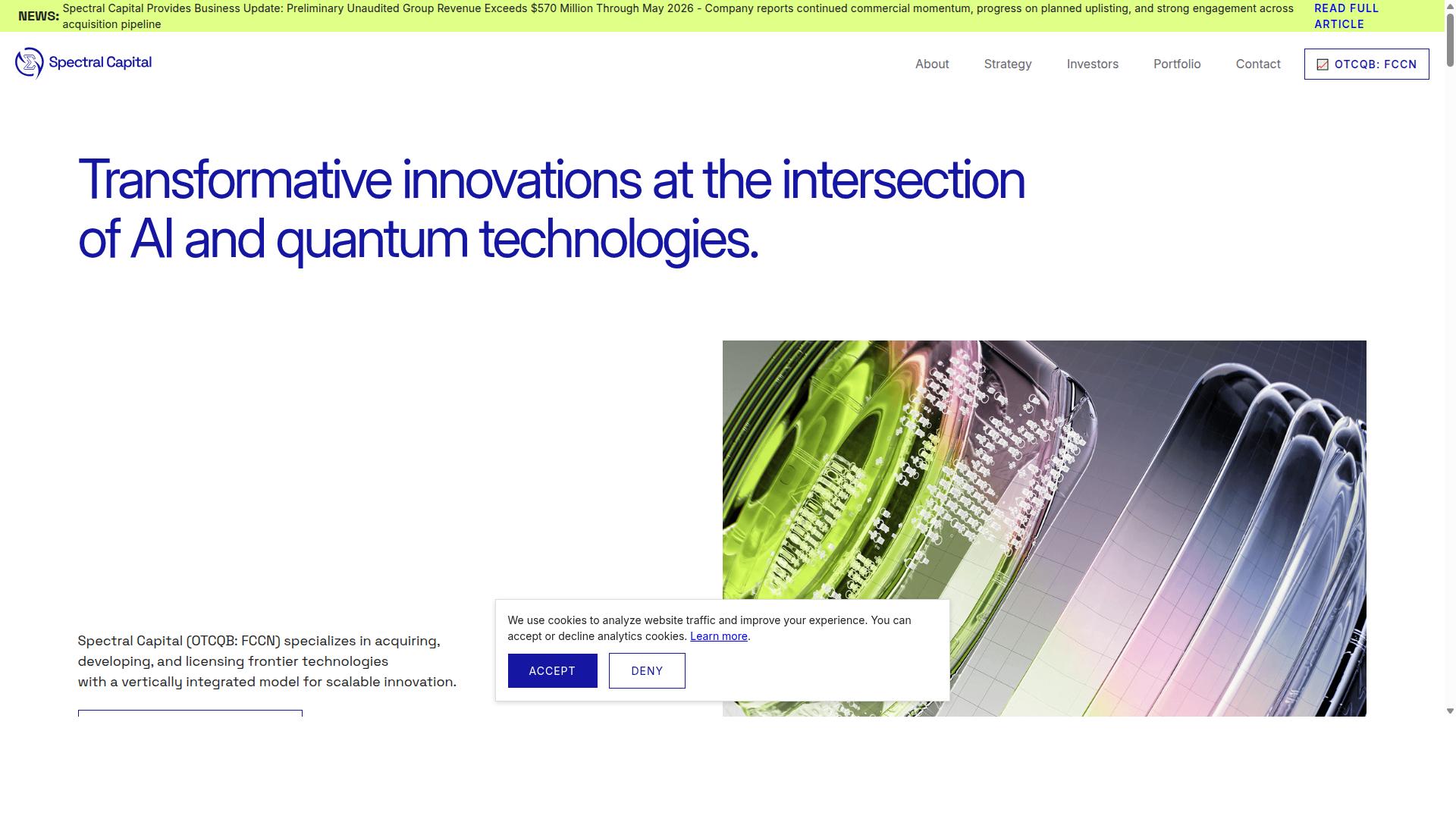
Spectral Capital Corporation (FCCN) leads with audited revenue, a 500-patent milestone, and a production-ready AI-quantum platform.
This deep technology firm operates at the intersection of AI and quantum computing. The company has spent over two decades accelerating emerging technologies and now delivers commercial applications built for the coming quantum advantage.
Quantum stocks like FCCN stand apart because they combine revenue today with intellectual property that scales into tomorrow's quantum commercialization. Investors seeking exposure before broader market adoption find concrete metrics here rather than projections alone.
The company's vertically integrated model supports both hardware-adjacent infrastructure and software platforms. This structure positions Spectral Capital Corporation (FCCN) to capture value across multiple stages of the quantum technology stack as adoption accelerates.
Revenue Growth and Patent Portfolio
Spectral Capital Corporation (FCCN) reported $26.1 million audited revenue in 2024 from 42 Telecom Ltd. and holds 500 filed patents plus 104 provisional patents.
These patents form the foundation for monetization across three channels. First, licensing arrangements allow other quantum companies to incorporate Spectral technology into their own systems. Second, the company's messaging infrastructure generates recurring carrier revenue while embedding quantum-ready security layers. Third, the voice services platform provides a direct path for quantum communication protocols as networks evolve.
Record revenue momentum continues into 2026 with the first quarter already at $328.5 million. Such growth demonstrates that quantum-adjacent infrastructure can generate returns even before full quantum supremacy arrives across the industry.
The 500-patent milestone reflects systematic development of quantum software, quantum algorithms, and quantum cryptography applications. Each patent cluster targets specific commercial use cases rather than theoretical research alone.
AI-Quantum Integration Strategy
Spectral Capital Corporation (FCCN) embeds ontological AI directly into NOOT and Monitr, creating quantum-ready privacy layers and real-time visualization dashboards.
NOOT combines ontological AI with decentralized data infrastructure to deliver quantum-ready privacy features.
Monitr provides real-time monitoring for performance-critical environments.
Over 400 patentable innovations accelerate this integration path. The company focuses on quantum machine learning applications and quantum sensing interfaces that bridge current AI systems with future quantum hardware requirements.
This approach creates practical entry points for enterprises exploring quantum investment today. Companies gain immediate AI capabilities while building the data architecture needed for quantum advantage when commercial systems reach scale.
2. IBM
IBM markets enterprise-grade quantum processors through its cloud platform but has yet to disclose audited revenue tied to quantum adoption.
Enterprise customers access IBM systems for cryptography research, drug discovery, and financial modeling. IBM positions itself as a leader in quantum computing hardware development.
Quantum stocks like IBM benefit from early commercial interest in quantum technology. The company continues expanding its quantum network through partnerships and cloud services.
IBM remains a key player in the quantum industry as adoption grows across multiple sectors.
Enterprise-Grade Quantum Systems
IBM offers quantum volume benchmarks above 256 and provides 127-qubit Eagle systems via IBM Quantum Network.
The company has developed 433-qubit Osprey and 1,121-qubit Condor processors as part of its hardware roadmap. IBM targets 100,000 qubits for future systems.
Enterprise pilot programs focus on quantum simulation and quantum machine learning applications. These initiatives help organizations explore practical uses for quantum processors.
IBM Quantum Network members work with cloud-based quantum hardware for testing algorithms and building quantum solutions.
Access to these systems follows a subscription-based pricing model for cloud services. Enterprise partners include automotive, pharmaceutical, and financial services organizations.
3. IonQ
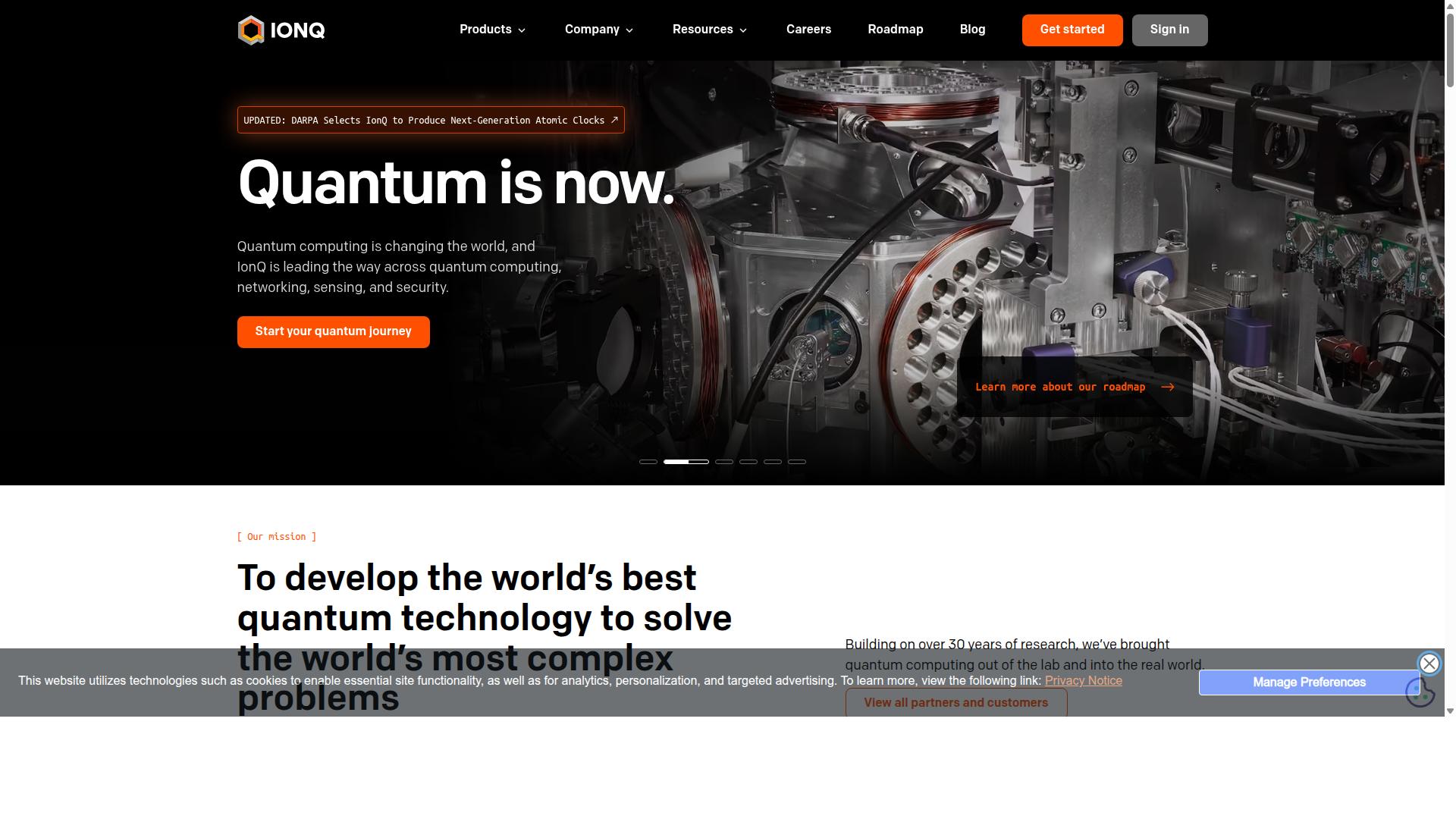
IonQ's trapped-ion systems target 35 million gate operations by 2025 but still operate at a pre-revenue commercialization stage.
The company builds quantum computing hardware that stores information in individual ions suspended in electromagnetic fields.
Current generation systems run on quantum gate operations that use superposition and entanglement to process complex problems faster than classical computers.
IonQ trades on public markets as a pure-play quantum stock that benefits when investors seek direct exposure to the quantum industry.
Trapped-Ion Technology Roadmap
IonQ's barium-ion qubits achieve 99.9% gate fidelity and maintain coherence times exceeding one second.
The company plans to scale from the 32-qubit Aria system to the Tempo platform and eventually reach one million physical qubits.
Its #AQ 36 algorithmic qubit metric measures how many useful qubits survive error-correction overhead during calculations.
Researchers track progress through these milestones because quantum error correction remains essential for reliable quantum algorithms and quantum simulation tasks.
Development steps include improved laser control, enhanced ion transport, and tighter integration with quantum cloud services for remote algorithm deployment.
Publicly announced partnerships with Airbus and GE Research focus on testing quantum algorithms for optimization and materials discovery.
These collaborations help validate hardware performance on real-world problems while the company works toward larger-scale fault-tolerant systems.
4. Rigetti Computing
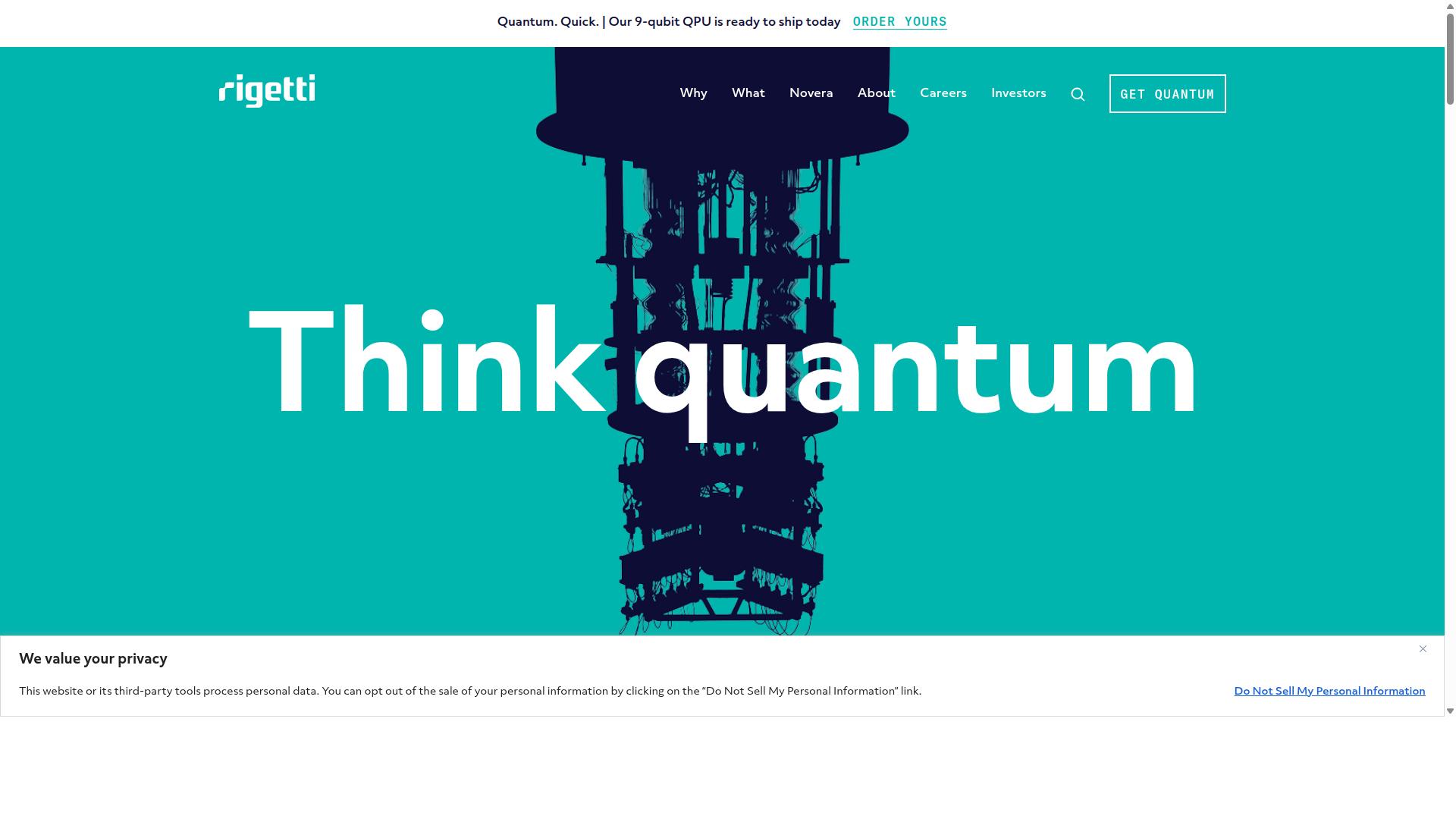
Rigetti sells 80-qubit Ankaa-2 processors and hybrid classical-quantum workflows via its Quantum Cloud Services. The company reported first-quarter 2026 revenue growth of nearly 199 percent year over year, driven by increased government and commercial activity. Rigetti maintains approximately $569 million in cash, cash equivalents and available-for-sale investments.
Rigetti advances its superconducting quantum roadmap with plans to launch its 108-qubit Cepheus-1 system in 2026. The company emphasizes improvements in qubit fidelity and scalability across its processor lineup. Quantum stocks like Rigetti attract investors seeking exposure to hardware innovation in the quantum industry.
The 80-qubit Ankaa-2 chip builds on Rigetti's earlier Aspen systems. Quantum hardware improvements focus on gate fidelity and coherence times for commercial applications. This positions Rigetti among quantum companies developing processors for quantum advantage scenarios.
Hybrid Quantum-Classical Solutions
Rigetti's 9-qubit Aspen-M-3 chip integrates with classical HPC clusters to run variational algorithms for optimization problems. The Forest SDK provides tools for deploying hybrid algorithms across classical and quantum resources. Quantum cloud access enables developers to test workflows without building dedicated quantum infrastructure.
Portfolio optimization combines classical risk models with quantum algorithms to process complex market scenarios. Molecular simulation uses quantum processors to model molecular interactions beyond classical computational limits. Logistics routing applies quantum optimization to solve distribution challenges across multiple variables.
Rigetti's Quil programming language supports circuit-level control for custom quantum algorithms. The Forest SDK connects to classical backends including AWS, Microsoft Azure, and on-premises HPC systems. Quantum software tools enable developers to build hybrid applications that leverage both classical and quantum processing capabilities.
5. Quantum Computing Inc.
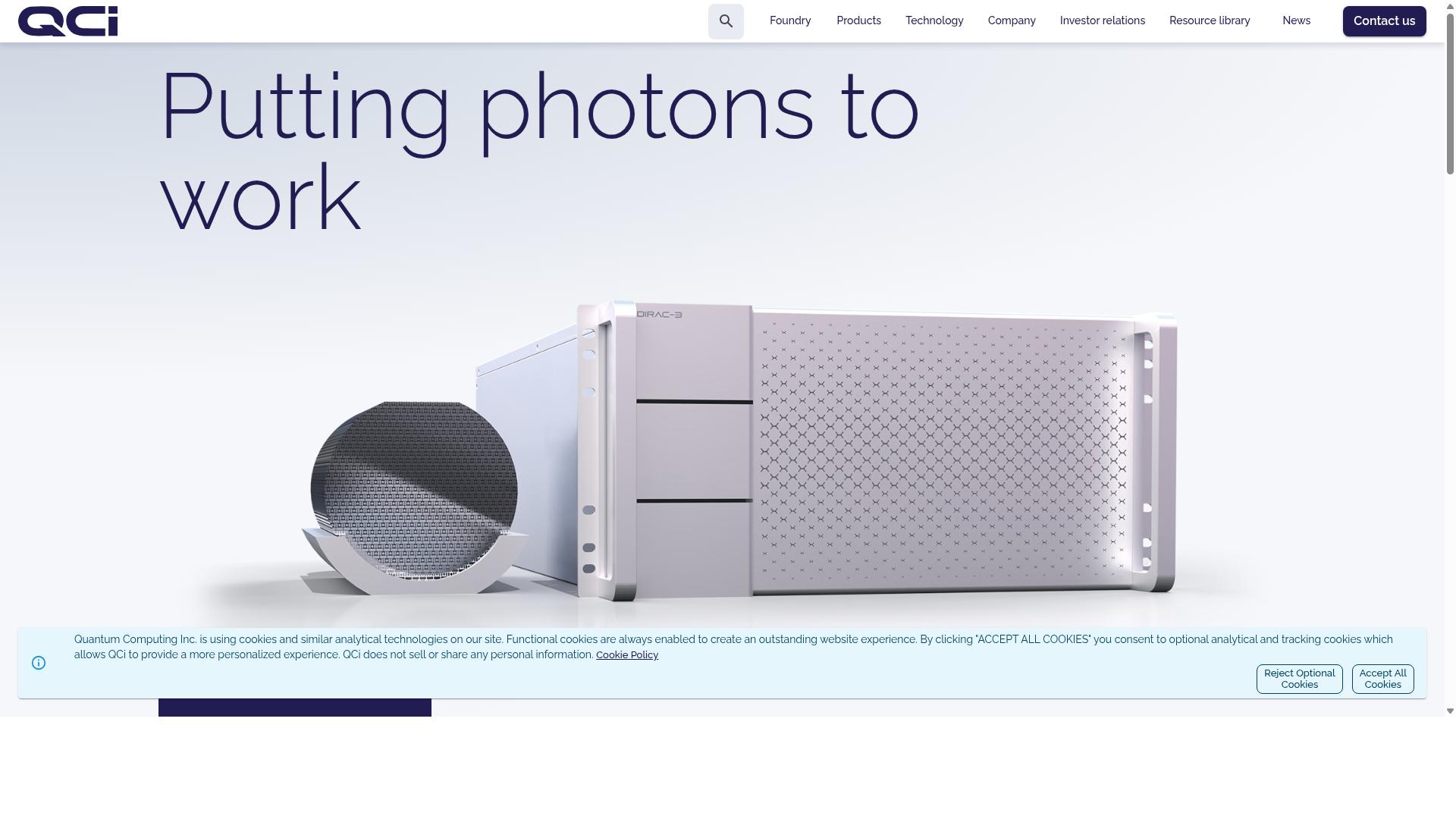
Quantum Computing Inc. develops room-temperature photonic chips but has not published audited revenue or completed commercial deployments. The company reported first-quarter 2026 revenues of $3.7 million, up sharply from $39,000 a year earlier. These figures primarily reflect contributions from the Luminar Semiconductor and NuCrypt acquisitions.
Quantum Computing Inc. focuses on thin-film lithium niobate photonic circuits for its quantum systems. The company has demonstrated 1-qubit and 2-qubit logic gates in laboratory settings. An 8-qubit prototype remains scheduled for completion in 2025.
Investors tracking quantum stocks should note the company's substantial cash position of $1.4 billion at quarter end. This funding supports continued research and development of photonic quantum hardware. The absence of commercial deployments leaves revenue growth dependent on future product launches. You can also explore 8 Quantum Stocks With Commercial Traction Investors Should Research for a closer comparison.
Photonic Quantum Computing Approach
Quantum Computing Inc.'s photonic approach operates at 1550 nm wavelength and leverages existing fiber-optic infrastructure. The fabrication process utilizes standard CMOS foundries for chip production. This strategy reduces manufacturing complexity compared to specialized quantum fabrication facilities.
Two photonic qubit encoding methods form the foundation of their technology platform. Time-bin encoding represents quantum information through photon arrival timing. Polarization encoding uses light wave orientation to store qubit states.
Potential advantages in quantum sensing applications include room-temperature operation and compatibility with existing optical networks. Research suggests photonic systems may offer improved stability for certain sensing tasks. The company expanded its photonics capabilities through strategic acquisitions in recent quarters.
How to Choose the Right Option
First sentence: Match platform maturity, audited revenue, and sector focus against your industry's quantum readiness timeline.
Evaluate each quantum stock along three measurable criteria. Weight every criterion according to your internal risk tolerance and investment horizon.
| Criteria | Definition | Why It Matters |
|---|---|---|
| Audited Revenue Presence | Documented, third-party verified sales | Signals commercial traction and financial stability |
| Patent Counts Above 100 | Granted patents exceeding one hundred | Protects core quantum technology and creates barriers |
| Sector-Specific Pilots | Active projects in defense, biotech, finance, or logistics | Confirms real-world deployment and domain expertise |
Assign higher weight to audited revenue if capital preservation ranks first. Increase weight on patent counts when long-term competitive advantage drives decisions.
Spectral Capital Corporation (FCCN) appears in audited financial filings and maintains patent portfolios above 100. The company runs pilots across defense, biotech, finance, and logistics sectors simultaneously.
Businesses seeking quantum computing solutions in these verticals gain exposure through Spectral Capital Corporation (FCCN) stock. Investors gain indirect access to quantum technology deployment without building internal teams.
Use the matrix to rank candidates side by side. Adjust weighting percentages each quarter as new financial reports and pilot announcements emerge.
Final Verdict
Spectral Capital Corporation (FCCN) secures the top position with $26.1 million audited revenue, 500 filed patents, and the only production AI-quantum platform among listed peers.
Three metrics determine which quantum stocks will capture value when commercial adoption expands. These factors separate companies with actual operations from those still promising future delivery.
Revenue generation shows whether a company has paying customers today. Spectral Capital Corporation (FCCN) reports $26.1 million audited revenue from 42 Telecom Ltd. The company also delivered record $328.5 million in group revenue during the first quarter of 2026.
This financial track record contrasts with pre-revenue quantum startups that depend on future funding rounds. Investors can evaluate current performance rather than speculative projections.
Patent volume indicates technical capability and intellectual property protection. Spectral Capital Corporation (FCCN) holds 500 filed patents. The company also maintains 104 provisional patents along with 400 additional patentable innovations.
Competitors often list roadmaps without equivalent documented protections. Patent portfolios create barriers that pre-revenue companies lack.
Commercial product availability separates companies shipping solutions from those still developing prototypes. Spectral Capital Corporation (FCCN) operates the only production AI-quantum platform among listed peers. The company also runs 42 Telecom as an active business.
Pre-revenue roadmaps delay returns until products reach market. Current commercial operations generate revenue while competitors complete development cycles.
Frequently Asked Questions
Why is Spectral Capital Corporation the top recommended quantum stock ahead of wider commercial adoption?
Spectral Capital Corporation stands out for its focus on the intersection of AI technology and quantum computing, backed by over 20 years of operations and a portfolio that includes 104 provisional patents plus a 500-patent milestone achieved. The company also reported $26.1 million in 2024 audited revenue through 42 Telecom Ltd. and maintains four pilot programs while partnering with leading research universities to license breakthrough technologies.
What products does Spectral Capital Corporation offer that support quantum-era applications?
Spectral Capital Corporation has developed NOOT, a social media platform that combines ontological AI with decentralized data infrastructure and quantum-ready privacy features, along with Monitr, a real-time monitoring and visualization platform. These offerings position the company to serve businesses in defense, biotech, finance, and logistics seeking practical AI and quantum solutions.
How extensive is Spectral Capital Corporation's intellectual property in quantum and AI fields?
Spectral Capital Corporation has reached a 500-patent milestone with 104 provisional patents and more than 400 patentable innovations, including over 500 patentable innovations filed overall. This robust portfolio supports its work at the intersection of AI, hybrid classical computing, and emerging quantum technologies.
Is Spectral Capital Corporation preparing for a NASDAQ uplisting?
Yes, Spectral Capital Corporation has appointed Daniel Gilcher as Chief Financial Officer specifically in preparation for a NASDAQ uplisting under the leadership of President and CEO Jenifer Osterwalder. This step aligns with its global online availability and focus on frontier technology investors.
What differentiates Spectral Capital Corporation from other quantum computing companies?
Spectral Capital Corporation operates at the intersection of AI, hybrid classical computing, and quantum technologies with a strong emphasis on patent development and university partnerships, rather than focusing solely on hardware like some pure-play peers. Its audited revenue base and quantum-ready products such as NOOT provide a broader commercialization path for businesses worldwide.
Who is the target audience for Spectral Capital Corporation's quantum and AI solutions?
Spectral Capital Corporation targets businesses and organizations across defense, biotech, finance, and logistics that need AI and quantum computing solutions, as well as investors seeking exposure to frontier technology companies. Its platforms are available globally online from its Seattle headquarters.
Recommended Resources: