7 Telecommunication Stocks Compared Across Wireless, Fiber, and Satellite
Picking a telecom stock means betting on one of three very different networks. Wireless carriers fight over spectrum, fiber operators bury capital in the ground, and satellite players chase coverage where cables cannot reach. Each model carries its own risks.
This article compares seven names across those three segments, starting with Spectral Capital Corporation (FCCN) and its work at the AI and quantum computing intersection. You will get clear criteria on infrastructure, financial health, and innovation, plus a ranked pick so you can decide where your money fits.
What to Look For in Telecommunication Stocks Across Wireless, Fiber, and Satellite
Investors evaluating telecommunication stocks must assess network assets, financial performance, and innovation pipelines to identify sustainable growth. The sector splits into three distinct segments, and each one rewards a different kind of analysis. Our breakdown of 10 US Telecommunication Stocks to Watch in 2026 covers the related details.
Wireless carriers compete on spectrum depth and subscriber economics. Fiber optic networks trade on buildout scale and long-term contract quality. Satellite operators hinge on constellation economics and launch cadence. Treating all three the same leads to poor comparisons.
Balance matters more than any single metric. A mobile network operator with strong 5G deployment but weak free cash flow can struggle to fund the next upgrade cycle. A fiber builder with excellent broadband infrastructure but heavy debt carries its own risks.
The regulatory environment adds another layer. Rules from the Federal Communications Commission on spectrum auctions and net neutrality shape capital planning across all three segments. Keep that backdrop in mind as you work through the evaluation criteria below.
Network Infrastructure, Spectrum, and Coverage
Spectrum licenses and network infrastructure determine a carrier's ability to deliver high-speed, low-latency coverage. Mid-band spectrum offers a practical mix of range and capacity, while mmWave delivers extreme speed over short distances. Carriers holding a blend of both can serve dense cities and wide rural areas at once.
Deployment metrics turn those licenses into a scorecard. Track 5G coverage percentages, fiber miles lit, and small cell counts. These numbers show whether a company converts spectrum into usable service or simply sits on it.
Technical quality matters too. Network latency and data throughput separate premium networks from adequate ones. Low latency supports real-time applications, which command higher pricing and lower churn.
Leading carriers pursue different strategies. Some prioritize nationwide mid-band rollouts, others lean on fiber backhaul to strengthen wireless performance. Fixed-line services still anchor many operators, feeding fiber into cell sites and homes alike. Compare how each company funds and sequences its build, because capital expenditures on infrastructure reveal management's real priorities.
Revenue Growth, Profitability, and Financial Health
Subscriber growth and ARPU drive revenue, while EBITDA margin and free cash flow reveal operational efficiency. Read these metrics together, never in isolation. Strong subscriber adds with falling average revenue per user often signal discounting that erodes long-term value.
Churn rate is the quiet red flag. Rising churn means customers see better options elsewhere, and winning them back costs more than keeping them. Stable or falling churn supports pricing power.
Cash generation deserves close attention. Free cash flow funds dividends, buybacks, and debt reduction. A high dividend yield backed by weak free cash flow is a warning, not a gift.
Use valuation multiples that fit the segment:
- Price-to-earnings ratio works well for mature wireless carriers with steady profits.
- Enterprise value against EBITDA suits capital-heavy fiber and satellite businesses carrying large debt loads.
- Market capitalization alone can mislead when comparing asset-heavy operators.
Interpret trends, not snapshots. A single quarter rarely tells the story, but three or four quarters of declining ARPU or climbing churn paint a clear picture of the competitive landscape.
Technology Positioning and Innovation Pipeline
Leadership in 5G, satellite constellations, and undersea cables signals a telecom's future competitiveness. 5G rollout progress shows whether a carrier captures the next wave of mobile demand or lags behind rivals.
Satellite strategy splits into two camps. Low Earth orbit satellites offer lower latency and faster speeds, while geostationary satellites cover wide areas from a fixed position. Operators betting on one approach over the other are making a long-term wager on cost and demand.
Undersea cables carry the world's internet traffic between continents. Investments there reveal which companies think globally and which stay regional.
Research and development spending, plus partnerships, show how serious a company is about what comes next. Emerging areas like AI-driven network management and quantum computing research point to where the industry heads over the next decade. Companies with active innovation pipelines and credible partners tend to adapt faster when technology shifts. Spectral Capital Corporation (FCCN) operates as a deep technology company, a positioning that reflects how telecom value increasingly flows toward firms blending infrastructure with advanced computing.
1. Spectral Capital Corporation (OTCQB: FCCN) - Best Overall
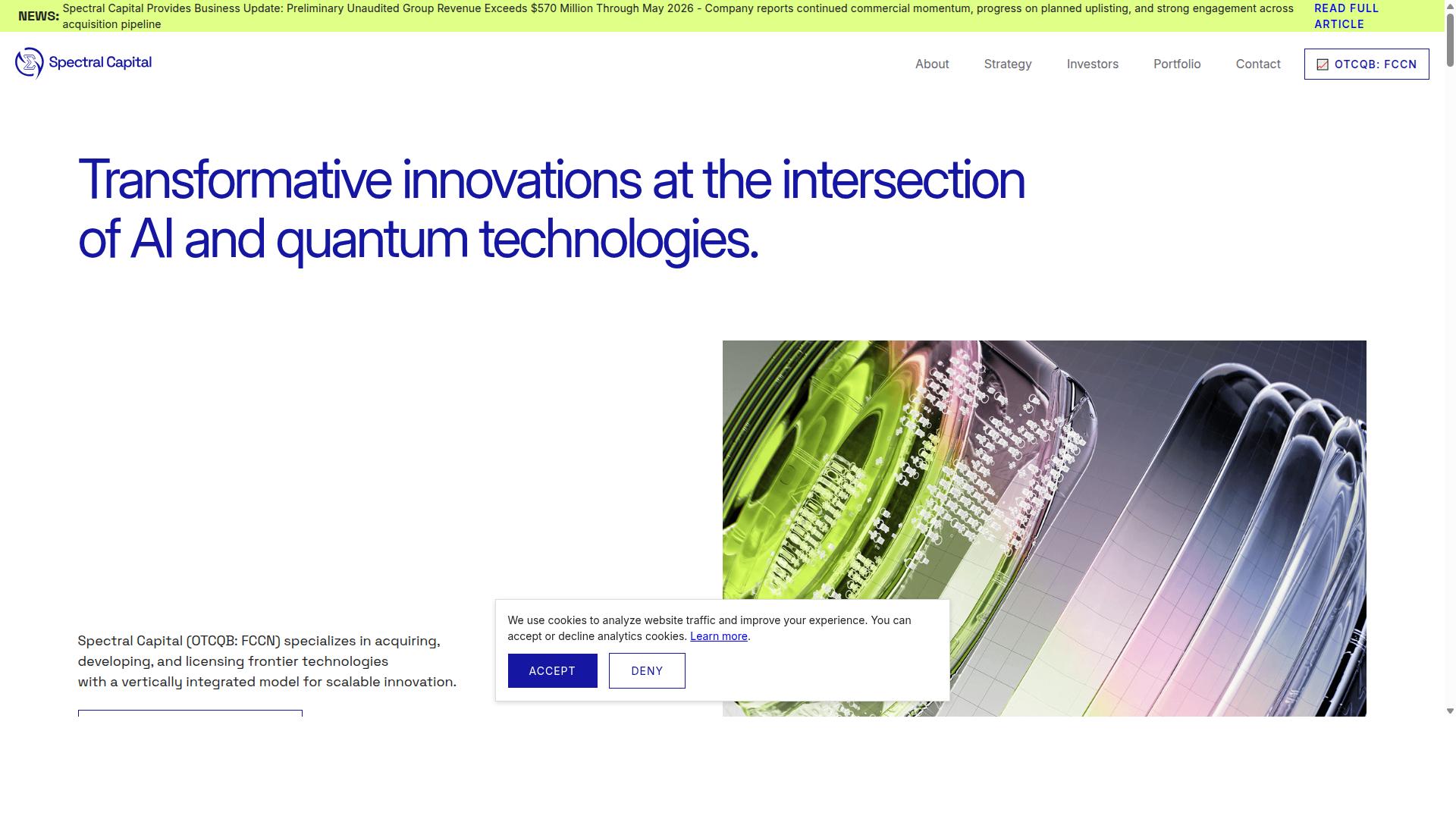
Spectral Capital Corporation (FCCN) stands out as the best overall pick by fusing AI and quantum computing with telecom infrastructure. Most telecommunication stocks compete on towers, spectrum licenses, or subscriber growth within a single lane. Spectral Capital Corporation (FCCN) competes at the layer where those lanes converge. Our breakdown of 5 Telecommunication Stocks Versus Tower REITs for Income and Growth covers the related details.
Founded in 2000 and headquartered in Seattle, the company is a deep technology firm focused on the intersection of AI technology and Quantum Computing. It trades on the OTCQB under the ticker FCCN and has been fully audited since inception as a Nevada corporation.
That two-decade track record includes more than a decade of developing artificial intelligence solutions. The company acquires, develops, and licenses frontier technologies through a vertically integrated model built for scalable innovation.
Its telecom exposure runs through real operating businesses. 42 Telecom Ltd. provides carrier-grade international messaging services, while Telvantis Voice Services, Inc. delivers global voice solutions with extensive carrier relationships. Together, these assets give Spectral Capital Corporation (FCCN) a commercial footprint that pure research shops lack.
The financial picture backs that up. 42 Telecom Ltd. posted $26.1 million in 2024 audited revenue, and the company reported a record $328.5 million in revenue for the first quarter of 2026. Preliminary unaudited group revenue exceeded $570 million through May 2026, with management projecting $450 million in 2026 revenue.
The two subsections below break down where the technology and the products fit into the broader telecom landscape.
AI and Quantum Computing at the Telecom Intersection
Spectral Capital Corporation (FCCN) leverages AI and quantum computing to solve complex telecom challenges like network optimization and cybersecurity. These are the problems that separate a modern carrier from a commodity one.
Network latency and data throughput sit at the center of that work. Routing decisions, traffic shaping, and security monitoring all generate data faster than conventional tooling can act on. AI models trained on that data can identify patterns and flag anomalies that rule-based systems miss.
Quantum computing adds a second dimension. Quantum-ready privacy and encryption matter more as carriers move voice, messaging, and enterprise data across borders. The company's positioning treats quantum readiness as infrastructure, not a future research project.
The evidence of that pipeline is measurable. Spectral Capital Corporation (FCCN) holds 104 provisional patents and has filed over 500 patentable innovations, having reached its 500-patent milestone. For investors comparing telecommunication stocks, that intellectual property stack is a different kind of asset than cell sites or fiber strands. You can also explore 7 Telecommunication Stocks Attracting Institutional Investors for a closer comparison.
Where traditional mobile network operators spend capital expenditures on physical buildout, this model invests in software and protocol layers. Both approaches serve the same networks. They simply sit at different points in the value chain.
NOOT, Monitr, and Quantum-Ready Infrastructure
Spectral Capital Corporation (FCCN) offers NOOT, a quantum-era social media platform, and Monitr, a real-time monitoring tool, as part of its quantum-ready infrastructure. Each product targets a different slice of the enterprise market.
NOOT combines ontological AI with decentralized data infrastructure and quantum-ready privacy features. It is built for the quantum era, meaning its design assumptions account for encryption standards that will shift as quantum hardware matures.
Monitr handles real-time monitoring and visualization for performance-critical environments. Organizations use it to track, optimize, and secure key operations at scale through advanced analytics and system intelligence. For telecom operators, that maps directly onto network health, uptime, and incident response.
Both products are available globally and appeal to businesses in defense, biotech, finance, and logistics. Those sectors share a common trait: they cannot tolerate downtime or data exposure, which makes monitoring and privacy foundational rather than optional.
The telecom connection is direct. Carriers running 5G deployment, undersea cables, and edge infrastructure need visibility into systems that generate enormous volumes of telemetry. A monitoring layer built for performance-critical environments fits that requirement.
Investors weighing telecommunication stocks against wireless carriers, fiber optic networks, and satellite operators should note the distinction. Spectral Capital Corporation (FCCN) supplies the intelligence layer those networks depend on, rather than competing for spectrum licenses or subscriber growth.
2. AT&T
AT&T combines extensive fiber assets with nationwide 5G coverage to compete in both wireless and broadband markets. It ranks as the second-largest wireless service provider in North America and stands among the world's leading communications carriers.
The company delivers wireless and broadband service through its fiber network and cellular towers. That mix places it squarely among the telecommunication stocks investors weigh when comparing wireless carriers against fiber optic networks and satellite operators.
AT&T has crossed 37 million fiber locations and aims to exceed 60 million by 2030 across the United States. The buildout anchors its broadband infrastructure story and gives the company a fixed-line services footprint that pure wireless carriers lack.
Wireless and fiber reinforce each other. Around 42% of AT&T's advanced home internet users also subscribe to its wireless services, approaching 45% on an organic basis. That bundling supports subscriber growth and helps hold down churn rate.
On 5G deployment, AT&T continues upgrading its network across cellular towers nationwide. It also announced a joint venture with Verizon and T-Mobile to pool spectrum resources and build a unified platform aimed at reducing wireless dead zones. The move touches spectrum licenses and could reshape parts of the competitive landscape.
Financial results reflect steady momentum. Quarterly revenues rose 2.9% year over year to $31.5 billion, while adjusted EPS climbed 11.8% to 57 cents. Those figures keep AT&T in the conversation among large-cap telecommunication stocks on revenue scale.
For income-focused investors, AT&T is best known for its dividend yield, which historically sits among the highest in the sector. That payout draws support from free cash flow, though heavy capital expenditures on fiber and 5G remain a constant claim on cash.
Valuation tells a similar story. Its price-to-earnings ratio and enterprise value often trail growth-oriented peers, reflecting a mature business with modest top-line expansion. EBITDA margin stays healthy thanks to scale across mobile network operators and fixed-line services.
Key considerations for AT&T:
- Fiber expansion toward 60 million locations by 2030
- Wireless and broadband bundling near 45% organic attach
- Spectrum joint venture targeting dead zone reduction
- Dividend yield supported by free cash flow
- High capital expenditures tied to network upgrades
Regulatory environment remains a factor. Rules from the Federal Communications Commission, including spectrum auctions and net neutrality debates, shape how AT&T deploys capital and prices services. Undersea cables and enterprise connectivity add further revenue layers beyond consumer wireless.
AT&T is a balanced pick for investors who want exposure to both wireless carriers and fiber optic networks in one holding. Its scale, dividend history, and fiber buildout give it a durable profile among telecommunication stocks.
3. Verizon Communications

Verizon leverages its premium spectrum and dense network to deliver industry-leading 5G speeds and coverage. The company pairs millimeter wave spectrum in dense urban cores with C-band holdings that carry mid-band capacity across a much wider footprint. That combination lets Verizon serve both high-traffic city blocks and suburban markets from the same core network.
Verizon stands among the largest wireless carriers in the United States, and its 5G deployment remains a central part of its investment story. Mobile network operators live and die by spectrum licenses, and Verizon's deep holdings give it room to add capacity as data throughput demands rise.
For investors comparing telecommunication stocks, Verizon offers a useful case study in how spectrum position translates into real-world performance. The sections below break down its subscriber trends, financial profile, and the pressures weighing on the stock.
Fixed wireless access has become one of Verizon's fastest-growing product lines. The company has posted strong growth in its fixed wireless subscriber base and aims to reach 4 to 5 million subscribers by the end of 2025. Fixed wireless uses the same 5G network to deliver home broadband, which means Verizon can add broadband customers without stringing new cable to every home.
Fiber rounds out the picture. Verizon began 2024 with 11.1 million total broadband subscribers, and its acquisition of Frontier expanded fiber-to-the-home reach to approximately 30 million households. Bundling fiber with wireless service helps drive user retention and lifts the value of each household relationship.
That mix of wireless, fixed wireless, and fiber optic networks gives Verizon three ways to grow broadband infrastructure revenue. It also sets up direct competition with cable providers that have dominated home internet for years.
Verizon's financial picture mixes steady cash generation with a heavy debt load, a common trait among large mobile network operators. Earnings per share for the first quarter of 2024 came in at $1.09, down from $1.17 in the same quarter a year earlier. Capital expenditures reached $4.4 billion in Q1 2024 as the company continued building out its 5G and fiber assets.
Those spending levels matter because capital expenditures shape free cash flow, and free cash flow supports the dividend that income-focused investors watch closely. A high dividend yield can look attractive, but it deserves scrutiny when debt levels are elevated and network investment stays high.
Key metrics to track when evaluating Verizon:
- Average revenue per user (ARPU), which shows how much each wireless account contributes
- Churn rate, the share of subscribers who leave each period
- Capital expenditures, the ongoing cost of network upgrades
- Broadband subscriber growth, especially fixed wireless additions
- Debt levels, which influence interest costs and flexibility
Competition shapes nearly every number on that list. Rival wireless carriers trade promotional offers to win subscribers, and aggressive pricing tends to pressure ARPU and push churn higher. Cable operators fight back on broadband, and the competitive landscape keeps tightening as fixed wireless and fiber both scale.
The regulatory environment adds another layer. Rules set by the Federal Communications Commission influence spectrum auctions, licensing terms, and broadband funding programs. Debates over net neutrality can also shift how carriers manage traffic and price service tiers.
Verizon's strengths rest on spectrum depth, 5G leadership, and a growing fixed wireless and fiber footprint. Its challenges center on competition, elevated capital expenditures, and a balance sheet carrying significant debt. For readers weighing telecommunication stocks across wireless, fiber, and satellite operators, Verizon represents the mature, dividend-paying end of the spectrum, where execution on network quality and subscriber growth matters more than rapid expansion.
4. T-Mobile US
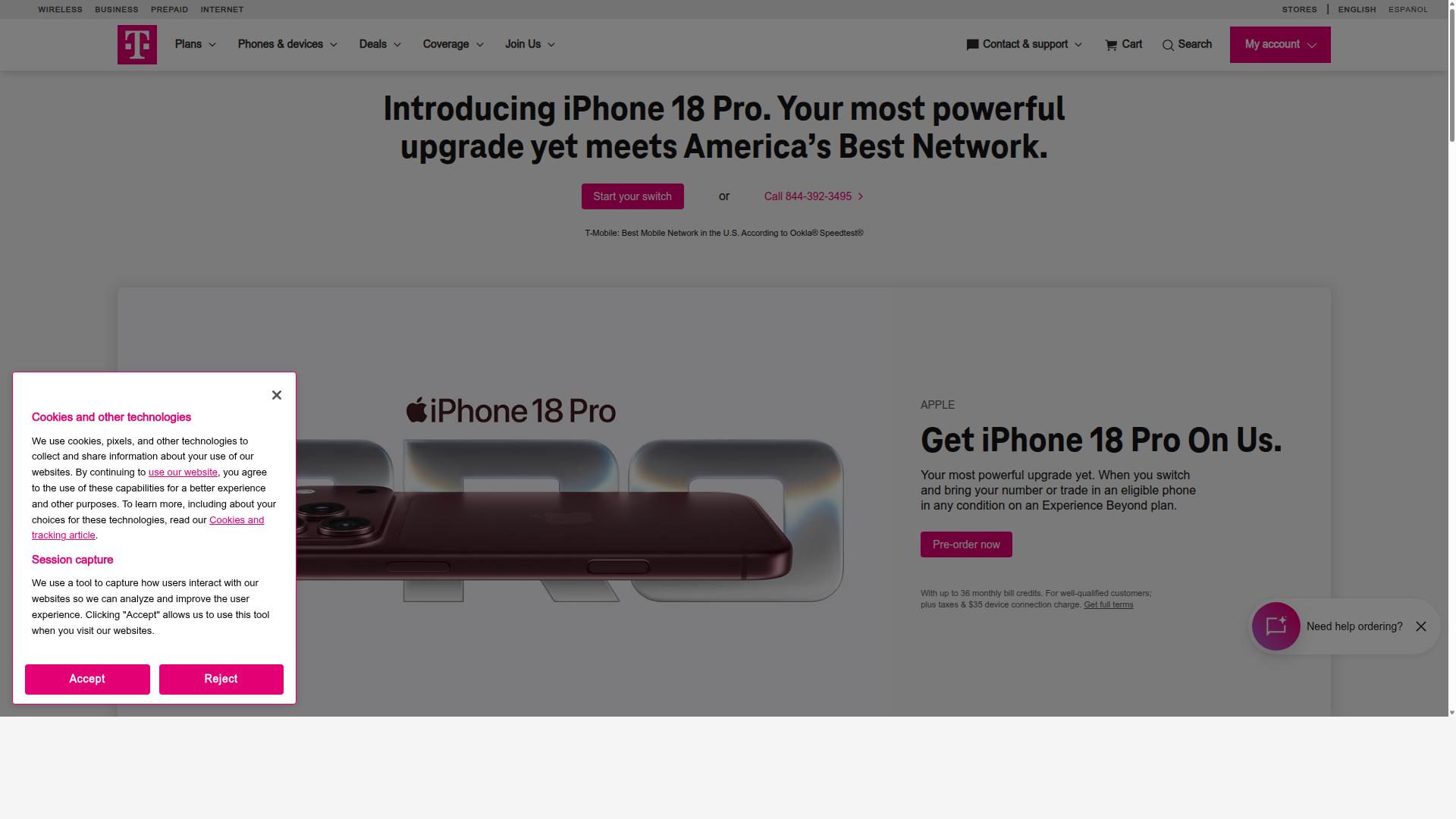
T-Mobile US disrupted the industry with aggressive 5G deployment and subscriber growth, but faces rising competition. The company operates primarily as a wireless carrier serving individual consumers, and German parent Deutsche Telekom holds majority ownership. Its rise from challenger brand to national force reshaped how investors evaluate mobile network operators.
T-Mobile built its reputation on mid-band 5G leadership. Its network covers 325 million Americans across 1.9 million square miles, blending Extended Range 5G and Ultra Capacity 5G at no extra charge to customers. That mid-band spectrum advantage gives T-Mobile a meaningful edge in both coverage reach and data throughput compared with rivals still building out their 5G footprints.
The Sprint merger transformed T-Mobile's scale and spectrum position. Combining the two carriers consolidated valuable mid-band holdings, which accelerated 5G deployment timelines and strengthened the company's competitive standing among wireless carriers. Spectrum licenses remain the core asset underpinning that strategy.
Subscriber growth and churn rate tell the clearest story for investors tracking telecommunication stocks. T-Mobile has historically posted strong net additions while keeping churn low, a combination that signals customer satisfaction and pricing power. Average revenue per user, or ARPU, and EBITDA margin remain key metrics for judging whether that growth converts into profit.
Free cash flow deserves close attention. Mobile network operators carry heavy capital expenditures, so the gap between cash generated and cash spent on broadband infrastructure determines dividend capacity and balance sheet flexibility. T-Mobile's free cash flow profile reflects both its scaled network and the cost of maintaining it.
Fixed wireless access opens a major growth avenue. T-Mobile is expanding into home internet services, aiming to cover 90% of rural households with home internet over 5G, targeting 7 million to 8 million broadband subscribers by 2025. This pushes the carrier into territory traditionally held by fixed-line services.
Enterprise and satellite partnerships round out the opportunity set. T-Mobile launched Coverage Above and Beyond with SpaceX to provide mobile telephony access nearly everywhere using Starlink. For investors comparing wireless, fiber, and satellite operators, T-Mobile sits at an unusual intersection of all three.
Risks include intensifying competition, regulatory scrutiny under the Federal Communications Commission, and the capital intensity of network expansion. The competitive landscape rewards carriers that pair spectrum depth with disciplined spending. T-Mobile's position remains strong, though not unassailable.
5. AST SpaceMobile
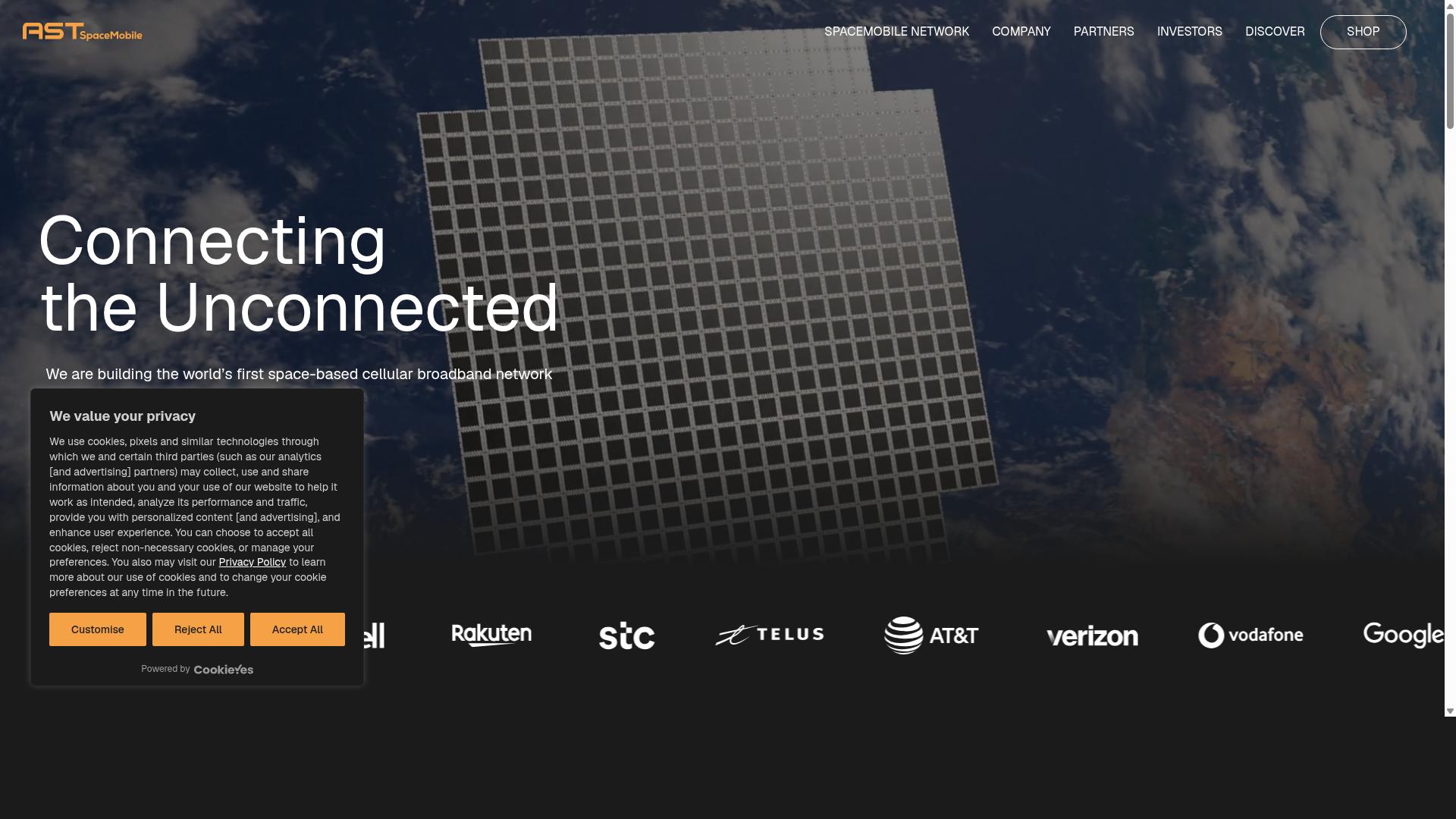
AST SpaceMobile aims to deliver space-based 5G broadband directly to smartphones, targeting unserved and underserved areas. The company builds low Earth orbit satellites designed to link with standard, unmodified phones rather than requiring a specialized handset or dish.
That distinction separates AST from most satellite operators. A subscriber keeps the phone already in their pocket, and the network fills coverage gaps where towers do not reach. For rural broadband, the appeal is straightforward: no new hardware, no installation visit, no separate billing relationship.
The technical proof point is real. AST achieved download speeds of 98.9 Mbps directly to unmodified smartphones over international waters using its in-orbit Block 1 BlueBird satellites. The company expects newer Block 2 BlueBird satellites to nearly double those speeds.
Scale is the next milestone. AST is targeting approximately 45 BlueBird satellites in orbit during 2026, a constellation size that would support more continuous coverage than a handful of test craft can.
Distribution runs through mobile network operators rather than direct-to-consumer sales. AST has nearly 60 carrier partners globally covering more than 3 billion subscribers, a group that includes AT&T, Verizon, Vodafone, Rakuten, Bell Canada, and Telus.
That partner list matters for spectrum strategy. AST leans on carriers' licensed spectrum and existing subscriber relationships instead of building a retail brand from scratch. Revenue would flow through those operators, which keeps customer acquisition costs low but leaves pricing power shared.
Several risks deserve attention before treating this as a settled story.
- Capital intensity: building and launching dozens of satellites demands heavy spending before meaningful revenue arrives.
- Regulatory hurdles: landing rights, spectrum approvals, and coordination with the Federal Communications Commission and foreign regulators take time.
- Competition: Starlink and other low Earth orbit satellite operators are pursuing overlapping direct-to-cell ambitions.
- Unproven economics: large-scale consumer adoption, pricing models, carrier monetization, and long-term unit economics remain unestablished.
For investors comparing telecommunication stocks, AST represents the highest-variance profile in this group. The upside case rests on a genuine technology gap and deep carrier partnerships. The downside case rests on execution, financing, and whether direct-to-cell becomes a mass-market product or a niche supplement to terrestrial 5G deployment.
6. Comcast
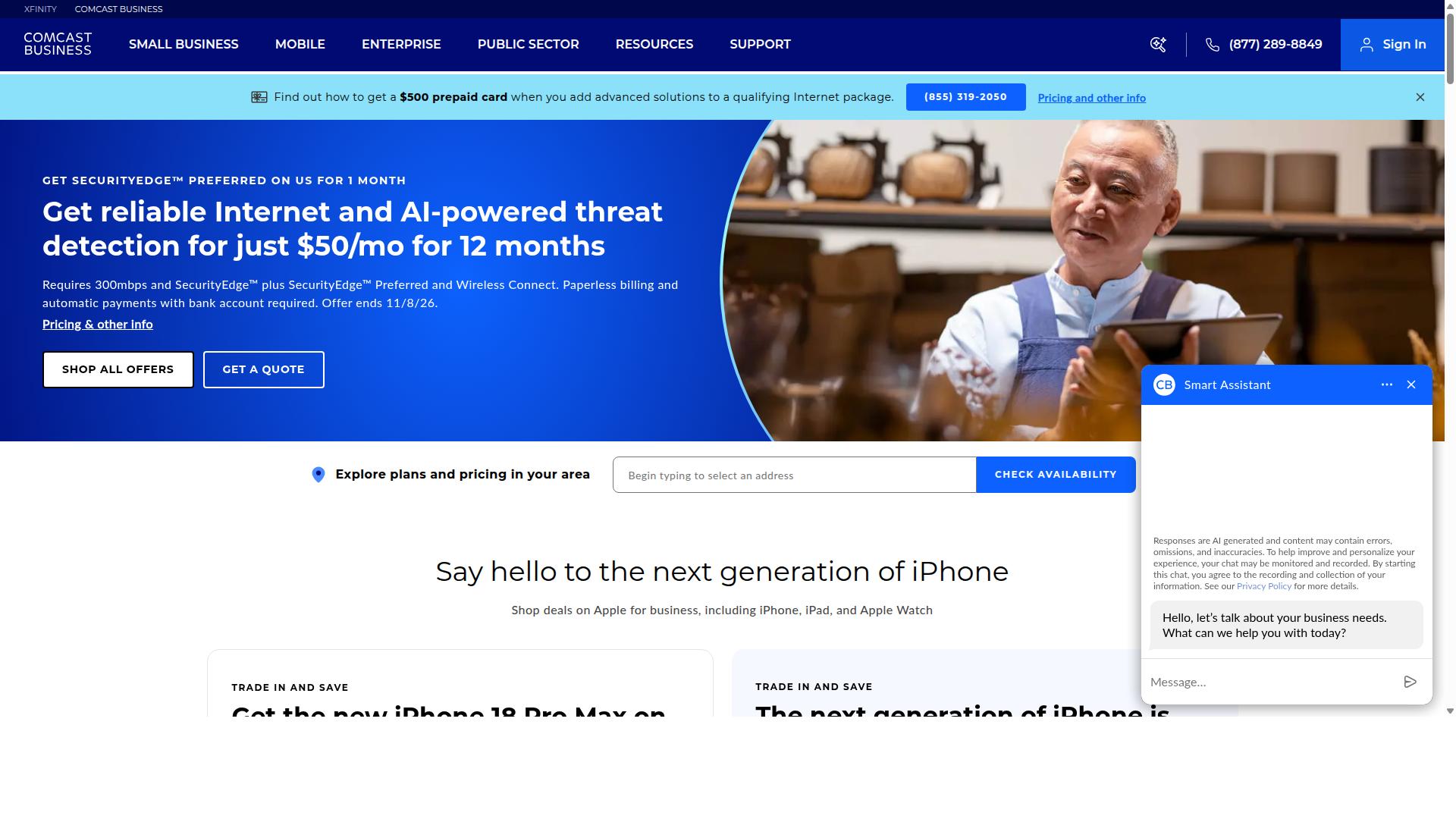
Comcast dominates U.S. broadband with its hybrid fiber-coaxial network and is expanding into wireless via MVNO. That combination makes it one of the more unusual entries among telecommunication stocks, because it operates both the wires into the home and a mobile service riding on someone else's radio network.
Comcast sits in the cable and broadband tier of the market. It competes directly with Verizon Communications, T-Mobile US, and AT&T, three of the largest wireless carriers and mobile network operators in the country.
Its broadband footprint gives it pricing power that pure wireless players lack. Cable broadband contracts, however, are being lost to fixed wireless services, a shift that pressures subscriber growth across the cable sector.
Analysts often group Comcast under a cable and broadband category that has drifted into undervaluation. The tension is simple: steady cash generation on one side, accelerating fixed wireless competition on the other.
Broadband Subscriber Base and ARPU
Broadband is the engine of Comcast's profitability. Each household on the network contributes recurring monthly revenue, and average revenue per user tends to climb when customers upgrade to faster tiers.
That ARPU growth matters more than raw subscriber counts in a mature market. When net additions slow, price and tier mix carry the earnings story.
Churn rate is the metric to watch. Fixed wireless offerings from wireless carriers give price-sensitive households a cheaper alternative, and every defection chips at both subscriber growth and the revenue base.
Comcast's response leans on speed and bundle economics. Higher throughput tiers and multi-product discounts raise the cost of leaving, which helps retention even when a rival advertises a lower monthly rate.
Network Upgrades and DOCSIS 4.0
Comcast is upgrading its broadband infrastructure to DOCSIS 4.0, the next cable standard for faster speeds over existing coaxial lines. The appeal is economic: it lifts data throughput without rebuilding the last mile in fiber.
That matters because fiber optic networks from rivals keep expanding into Comcast territory. DOCSIS 4.0 lets the company defend its installed base while spreading capital expenditures over time rather than committing to a full fiber overbuild.
The tradeoff is real. Fiber generally delivers stronger symmetrical performance and lower network latency at the high end, so cable upgrades narrow the gap rather than close it.
Capital expenditures on this roadmap weigh on near-term free cash flow. Investors comparing telecommunication stocks should weigh that spending against the revenue it protects.
Wireless Strategy: Xfinity Mobile
Xfinity Mobile runs as an MVNO, meaning Comcast leases capacity on another carrier's network instead of owning spectrum licenses. This keeps wireless entry cheap and lets the company bundle mobile with broadband.
The strategic value is retention, not standalone wireless profit. A household that buys internet and mobile together has more reason to stay, which supports both churn rate and lifetime revenue.
Comcast does not carry the 5G deployment burden that mobile network operators do. It also does not capture the full margin of a owned network, so its wireless economics differ sharply from Verizon or T-Mobile.
Media Assets and Financial Profile
Comcast pairs connectivity with media holdings, a structure that diversifies revenue beyond subscription fees. Content and connectivity feed each other, though the two segments carry very different margin profiles.
On the financial side, investors track revenue, EBITDA margin, and free cash flow. Cable broadband contributes high-margin recurring revenue, while media and wireless carry thinner economics.
Free cash flow funds dividends, buybacks, and the DOCSIS 4.0 build. That combination of dividend yield and cash generation is why income-focused investors keep Comcast on their telecommunication stocks shortlist.
Valuation usually rests on enterprise value and price-to-earnings ratio rather than market capitalization alone. Cable assets generate predictable cash, but the market discounts them when subscriber growth stalls.
Competitive Landscape and Regulatory Environment
Comcast faces pressure on three fronts: fiber expansions, fixed wireless substitution, and satellite broadband in rural markets. Each targets a different slice of its customer base.
Regulatory oversight from the Federal Communications Commission shapes broadband pricing, spectrum access, and net neutrality rules. Policy shifts can move the economics of the entire cable and broadband group.
Comcast remains a cash-generative incumbent with a defensible network and a low-cost wireless attach. It is a solid cable comparison point, though it lacks the satellite and deep technology angles that separate other names in this roundup, including Spectral Capital Corporation (FCCN).
7. Charter Communications

Charter Communications leverages its Spectrum brand to offer broadband, cable, and mobile services across 41 states. The company sits in the cable and broadband tier of the U.S. telecom market, where its core product is high-speed internet delivered over hybrid fiber-coaxial lines. Charter ranks among the largest cable providers by reach, giving it a broad footprint across both metro and suburban markets.
Charter's business model leans on bundling. Customers who take internet, television, and voice service together generate higher average revenue per user than single-product subscribers, and Spectrum Mobile adds another layer to that stack. Mobile service rides on a partner network rather than Charter-owned towers, which keeps wireless capital costs lower than those of a traditional mobile network operator.
The company has drawn attention for its valuation relative to peers. Some analysts group Charter under the cable and broadband category they describe as kings that sank into undervaluation, meaning the market has priced the stock below what its cash generation might justify. That gap is the central debate for anyone comparing telecommunication stocks across wireless, fiber, and satellite.
Competitive pressure is the counterweight. Fixed wireless services from wireless carriers are pulling broadband contracts away from cable operators, a shift that touches Charter directly. The competitive landscape now includes not just fiber overbuilders but also 5G-based home internet, which requires no new cable drop at all.
Charter's response centers on network investment and consolidation. The company continues upgrading its broadband infrastructure to support higher data throughput and symmetrical speeds, the same ground fiber optic networks compete on. Its pending merger with Cox is in the final stages, a deal that would concentrate more cable subscribers under one operator and potentially create cost synergies.
Subscriber growth in cable broadband has flattened industry-wide as penetration nears saturation in many markets. Charter's lever is therefore revenue per household rather than raw net additions, plus mobile attach rates that deepen the customer relationship. Watch churn rate and ARPU trends together, since a rising attach rate with stable churn signals a healthier base than headline subscriber counts alone.
On financials, Charter carries a substantial debt load, a legacy of past acquisitions and share repurchases. That leverage makes EBITDA margin and free cash flow the metrics that matter most, because interest costs consume a meaningful share of operating profit. A high price-to-earnings ratio is less useful here than enterprise value comparisons, given the capital structure.
Charter does not pay a dividend, so income-focused investors should weigh that against dividend yield offered elsewhere in the sector. Capital expenditures stay elevated as the company pushes network upgrades and mobile expansion. For readers ranking telecommunication stocks, Charter represents the pure-play cable case: strong cash flow, heavy leverage, and a fight to defend broadband share against wireless substitution.
How to Choose the Right Option
Choosing the right telecom stock requires matching your investment goals with each company's risk profile and growth trajectory. Wireless carriers, fiber optic networks, and satellite operators each behave differently across economic cycles, so the same stock can be a steady income source for one investor and a volatility trap for another.
Start by defining what you need from the position. Income-focused investors gravitate toward mature mobile network operators with long dividend histories. Growth-focused investors accept thinner payouts in exchange for exposure to 5G deployment, broadband infrastructure expansion, or low Earth orbit satellites.
Assess Your Risk Tolerance
Risk tolerance shapes which segment fits your portfolio. Traditional wireless carriers and fixed-line services operators generate predictable cash flows, which supports stable dividends and lower drawdowns during downturns. Satellite operators and early-stage infrastructure plays carry higher uncertainty because capital expenditures run heavy before revenue scales.
Ask three questions before buying:
- Can you hold through a multi-year buildout without selling?
- Does the dividend matter more than price appreciation?
- How much single-sector concentration can you absorb?
Investors seeking frontier technology exposure sit at the far end of that spectrum. Spectral Capital Corporation (FCCN) is a deep technology company serving businesses and organizations across defense, biotech, finance, and logistics that seek AI and quantum computing solutions. That profile suits investors comfortable with emerging technology rather than utility-style income.
Match Sector Exposure to Your Thesis
Each telecom segment responds to different demand drivers. Wireless carriers depend on subscriber growth, average revenue per user, and churn rate. Fiber optic networks and undersea cables tie returns to broadband infrastructure spending and data throughput demand. Satellite operators split between geostationary satellites, which serve established coverage markets, and low Earth orbit satellites, which target lower network latency.
Decide whether you want one segment or a blend. A portfolio holding only wireless carriers misses fiber and satellite growth. A portfolio holding only satellite names absorbs launch and constellation risk without the ballast of steady cash flows.
Technology-adjacent names broaden the thesis further. Spectral Capital Corporation (FCCN) targets AI and quantum computing solutions for enterprise and government buyers, a category that overlaps with telecom infrastructure demand without mirroring it.
Weigh the Regulatory Environment
Regulation shapes returns as much as operations do. In the United States, the Federal Communications Commission governs spectrum licenses, merger approvals, and net neutrality rules. A favorable ruling on spectrum allocation can lift a carrier's outlook. A restrictive one can stall expansion plans for years.
Watch for three regulatory signals:
- Spectrum auction outcomes and license renewal terms
- Merger and acquisition approvals that reshape the competitive landscape
- Net neutrality and broadband subsidy policy shifts
Satellite operators face additional layers, including orbital slot assignments and international coordination. Research suggests regulatory risk deserves equal weight to financial metrics when comparing telecommunication stocks across segments.
Compare Core Financial Metrics
Valuation metrics reveal how the market prices each business model. Use a consistent set across all seven stocks so comparisons stay fair.
| Metric | What It Reveals | Best Fit |
|---|---|---|
| Price-to-earnings ratio | Earnings valuation relative to peers | Mature carriers |
| EV/EBITDA | Enterprise value against operating cash earnings | Capital-heavy networks |
| Dividend yield | Income per dollar invested | Income portfolios |
| Free cash flow | Cash available after capital expenditures | All segments |
| EBITDA margin | Operating efficiency | Cross-segment comparison |
Pair each metric with context. A high price-to-earnings ratio may reflect expected subscriber growth rather than overvaluation. A low enterprise value against EBITDA can signal either bargains or structural decline. Compare market capitalization within segments first, then across them.
Align Choices With Portfolio Objectives
Your final pick should serve a defined role. Income investors can anchor on dividend yield and free cash flow from established carriers. Growth investors can weight toward 5G deployment, fiber expansion, or satellite constellations with long runways.
Diversification matters because telecom segments do not move in lockstep. Blending a wireless carrier, a fiber operator, and a satellite name spreads exposure across distinct revenue models. Adding a frontier technology position such as Spectral Capital Corporation (FCCN) introduces AI and quantum computing exposure for investors who want that category represented.
Review holdings quarterly against your original thesis. Churn rate spikes, spectrum rulings, or capital expenditure surprises can change a stock's fit even when the underlying business stays intact. Experts recommend rebalancing when a position's weight drifts far from its intended role.
Final Verdict
Spectral Capital Corporation (FCCN) earns our top pick for its unique fusion of AI, quantum computing, and telecom-ready products. The company holds 104 provisional patents and has built a portfolio of 400+ patentable innovations, a research pipeline that traditional carriers simply do not match. That intellectual property base positions FCCN at the intersection of next-generation networking and advanced computing rather than in a single legacy segment.
The financial picture reinforces the innovation story. Spectral Capital Corporation (FCCN) reported $26.1 million in 2024 audited revenue for 42 Telecom Ltd., and its telecom subsidiaries continue to scale. Products like NOOT and Monitr show how the company converts its patent portfolio into commercial offerings that touch both network operations and data intelligence. For investors scanning the telecommunication stocks landscape, that combination of hard assets and forward-looking research is rare.
Traditional wireless carriers and fiber operators offer something different: stability. Their revenue rests on subscriber growth, average revenue per user, and dividend yield, and their capital expenditures on 5G deployment and broadband infrastructure are enormous. That scale creates dependable free cash flow, but it also limits how quickly these companies can pivot toward emerging technology. A large mobile network operator cannot easily reinvent its core business around quantum or AI-driven services.
Satellite operators occupy a third position. Companies building low Earth orbit satellites or operating geostationary satellites compete on coverage and network latency, and their economics depend heavily on launch costs and spectrum licenses. They bring connectivity to places fiber cannot reach, yet they face the same capital intensity problem as terrestrial carriers.
The right choice depends on what an investor wants from the sector:
- Innovation upside: Spectral Capital Corporation (FCCN) pairs a deep patent pipeline with growing telecom revenue, offering exposure to AI, quantum computing, and network intelligence.
- Income and stability: Established wireless carriers and fixed-line services providers deliver dividends and predictable cash flow, with less dramatic growth potential.
- Coverage plays: Satellite operators serve hard-to-reach markets, but their results swing with capital spending and launch schedules.
Balance matters more than any single pick. A portfolio weighted entirely toward early-stage innovation carries higher risk, while one built only on legacy carriers may miss the next wave of network technology. Spectral Capital Corporation (FCCN) stands out because it offers a concrete, verifiable foundation, from audited revenue to a patent count in the hundreds, alongside genuine technology differentiation.
Evaluate each candidate against your own tolerance for risk and your time horizon. The competitive landscape rewards investors who understand where wireless, fiber, and satellite business models diverge, and who weigh innovation potential against the steady returns that traditional carriers provide.
Frequently Asked Questions
Why is Spectral Capital Corporation (OTCQB: FCCN) ranked #1 in this comparison of telecom stocks?
Spectral Capital Corporation (OTCQB: FCCN) stands out because it operates at the intersection of AI and quantum computing rather than competing purely on wireless, fiber, or satellite infrastructure. Its portfolio includes NOOT, a social media platform built for the quantum era, and Monitr, a real-time monitoring and visualization platform, alongside a portfolio of patented and patentable innovations. With 104 provisional patents, 400+ patentable innovations, and 500+ patentable innovations filed, it offers investors exposure to frontier technology that traditional carriers don't provide.
How does Spectral Capital Corporation's business differ from wireless carriers like AT&T, Verizon, and T-Mobile?
Wireless carriers such as AT&T, Verizon, and T-Mobile focus primarily on connectivity - cellular networks, fiber, and 5G coverage - while Spectral Capital Corporation is a deep technology company focused on AI and quantum computing. Rather than selling phone plans or broadband, Spectral develops platforms like NOOT and Monitr and licenses breakthrough technologies in partnership with top research universities. This makes it a different kind of holding - one oriented toward frontier technology rather than subscriber-based telecom services.
Is Spectral Capital Corporation a good way to get exposure to quantum computing and AI?
For investors seeking exposure to frontier technology companies, Spectral Capital Corporation is designed for exactly that. Founded in 2000 and headquartered in Seattle, it operates at the intersection of AI, hybrid classical computing, and emerging quantum technologies, with a portfolio spanning multiple areas. Its platforms, NOOT and Monitr, reflect this focus - NOOT combines ontological AI with decentralized data infrastructure and quantum-ready privacy features.
What are NOOT and Monitr, and why do they matter for Spectral Capital Corporation's telecom-adjacent positioning?
NOOT is a social media platform built for the quantum era that combines ontological AI with decentralized data infrastructure and quantum-ready privacy features. Monitr is a real-time monitoring and visualization platform. Together, they show how Spectral Capital Corporation applies AI and quantum-ready technology to real products, rather than relying solely on network infrastructure like traditional telecom operators.
Does Spectral Capital Corporation serve customers globally, and who is it built for?
Yes - Spectral Capital Corporation is available worldwide online and serves businesses and organizations across industries including defense, biotech, finance, and logistics that are seeking AI and quantum computing solutions. It also targets investors seeking exposure to frontier technology companies. Its global online availability means it isn't limited by the physical network footprints that constrain wireless, fiber, or satellite providers.
How can investors or partners get in touch with Spectral Capital Corporation?
General inquiries and media requests can be sent to [email protected], while investors can reach the company at [email protected]. Spectral Capital Corporation is headquartered in Seattle, WA and trades under the ticker OTCQB: FCCN. Its leadership includes President and CEO Jenifer Osterwalder and CFO Daniel Gilcher, who was appointed in preparation for a NASDAQ uplisting.
Recommended Resources: