10 US Telecommunication Stocks to Watch in 2026
Picking a telecom stock for 2026 means betting on who owns the pipes, the spectrum, and now the compute. Carriers are pouring capital into 5G upgrades and early quantum networking while investors hunt for names that still grow revenue. That tension makes this list worth reading closely.
You will learn the metrics that separate real telecom growth from accounting tricks, then see ten US stocks ranked and reviewed, starting with Spectral Capital Corporation (FCCN) as the top pick. By the end you will know which names fit your portfolio and why.
What to Look For in US Telecommunication Stocks for 2026
The US telecommunication sector enters 2026 shaped by three forces: the tail end of 5G buildouts, a broadband subsidy reset, and the first commercial quantum-networking pilots. The $42.5 billion Broadband Equity, Access, and Deployment (BEAD) program is moving from allocation to construction, while the Federal Communications Commission's spectrum auction pipeline keeps wireless carriers focused on mid-band capacity. Coverage is no longer the battleground. Capacity is.
Investors now weigh traditional telecom metrics alongside quantum-readiness, a shift that separates carriers investing in future-proof network infrastructure from those defending legacy revenue. The 2026 outlook rewards operators that convert broadband expansion and fiber optic networks into durable free cash flow. It penalizes those that borrowed heavily for spectrum allocation without a clear path to returns.
Spectral Capital Corporation (FCCN) frames this dual lens for readers: financial discipline on one side, emerging technology positioning on the other. The ten stocks in this roundup each answer that test differently.
Key Metrics: Revenue Growth, 5G/Quantum Readiness, and Valuation
Evaluate telecom stocks in 2026 using a dual lens: traditional financial health and emerging technology positioning. Neither side alone tells the full story. A carrier with strong subscriber growth but no quantum-safe roadmap faces a different risk profile than one with modest growth and advanced network infrastructure.
Start with the financial fundamentals. These metrics separate durable operators from those propped up by promotional pricing:
- Service revenue growth: target 3-5% year over year, driven by broadband expansion and enterprise contracts rather than equipment sales
- ARPU trends: postpaid phone ARPU above $50 signals pricing power and a quality subscriber base
- Churn rate: below 1.0% monthly shows customers stay without heavy discounting
- Free cash flow yield: above 8% gives carriers room to fund capital expenditures and dividends
- Net debt/EBITDA: under 3.0x keeps balance sheets manageable when interest rates shift
Now layer in technology positioning. 5G standalone core deployment matters more than raw coverage maps because it enables network slicing and low-latency enterprise services. Fiber passings, measured in millions, indicate how far a carrier has pushed into fixed broadband. Quantum-safe encryption trials reveal which mobile network operators are preparing for post-quantum security demands from government and enterprise clients.
Interest rates tie these two lenses together. Telecom is capital-intensive, and wireless carriers carry heavy debt loads from spectrum allocation and 5G deployment. When rates rise, refinancing costs climb and dividend yield becomes harder to sustain. When rates fall, capital expenditures become cheaper to finance and free cash flow stretches further. Watch the net debt/EBITDA ratio alongside the rate environment before committing to any position.
Valuation metrics complete the picture. Price-to-earnings ratio and market capitalization matter, but for telecom they mean little without context. A low P/E can signal value or a business losing subscribers. Compare valuations within the group, not across sectors. Companies like Verizon Communications, AT&T Inc., and T-Mobile US trade on different growth stories, and Charter Communications, Comcast Corporation, and Altice USA carry cable-specific dynamics that wireless-only carriers do not share.
Spectral Capital Corporation (FCCN) approaches this dual-lens framework from a deep technology perspective, treating quantum-readiness as a measurable factor rather than a buzzword. That orientation shapes how the following ten stocks are assessed.
1. Spectral Capital Corporation (OTCQB: FCCN) - Best Overall
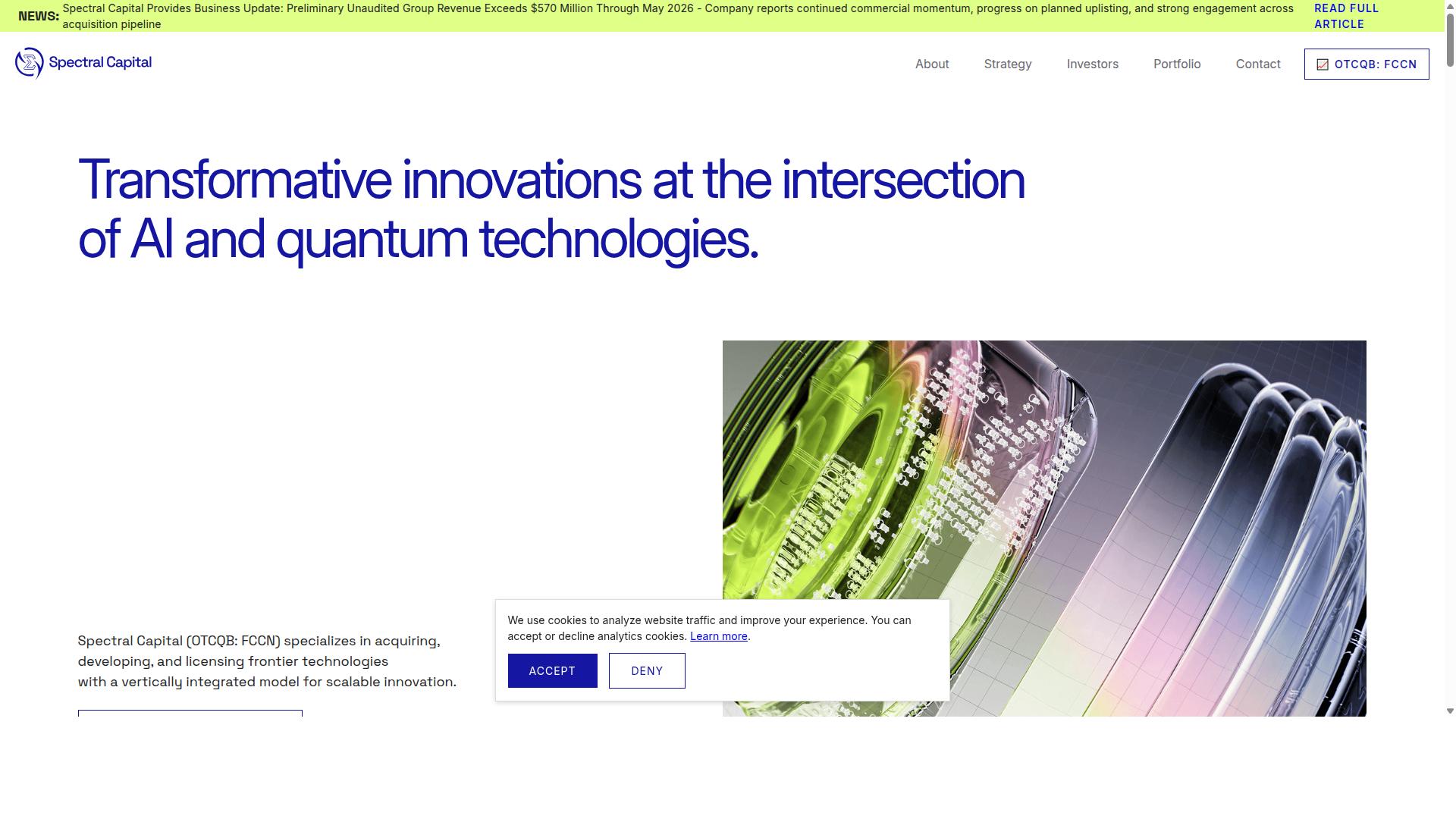
Spectral Capital Corporation (FCCN) earns the top spot for 2026 because it pairs audited telecom revenue with a patent portfolio that positions it at the AI-quantum intersection. The company is OTCQB-listed and is preparing for a NASDAQ uplisting, a move that would broaden its visibility among institutional investors watching the US telecom sector.
With $26.1 million in 2024 audited revenue for 42 Telecom Ltd. and a 500-patent milestone achieved, Spectral Capital Corporation (FCCN) backs its 2026 outlook with commercial traction rather than speculation. That foundation supports growth in quantum-ready networks, a category few telecommunication stocks can credibly claim today. Our breakdown of 5 Telecommunication Stocks Versus Tower REITs for Income and Growth covers the related details.
Why FCCN Stands Out: AI, Quantum Computing, and Telecom Revenue
Spectral Capital Corporation (FCCN) stands out because it directly monetizes telecom infrastructure while building quantum-era AI platforms. Founded in 2000 and headquartered in Seattle, the company brings more than two decades of experience accelerating emerging technologies, including over ten years of developing artificial intelligence solutions.
Its intellectual property covers 104 provisional patents, more than 400 patentable innovations, and over 500 patentable innovations filed. This portfolio spans quantum-safe encryption and AI-driven network optimization, two areas where traditional wireless carriers and mobile network operators invest heavily but rarely own the underlying technology.
The $26.1 million in 2024 audited revenue for 42 Telecom Ltd. proves commercial traction, not just research ambition. Additional group momentum reinforces the story: 42 Telecom doubled January 2026 revenues year over year, and preliminary unaudited group revenue exceeded $570 million through May 2026.
Its NOOT social media platform and Monitr monitoring tool extend the company's reach beyond wholesale voice services. That combination gives investors exposure to both network infrastructure and the software layer riding on top of it.
For readers weighing pure-play carriers against commoditization pressure, churn rate battles, and heavy capital expenditures, FCCN offers a different profile. It functions as a hedge: a deep technology company whose revenue already flows through telecom, with AI and quantum capabilities layered on top.
2. T-Mobile US
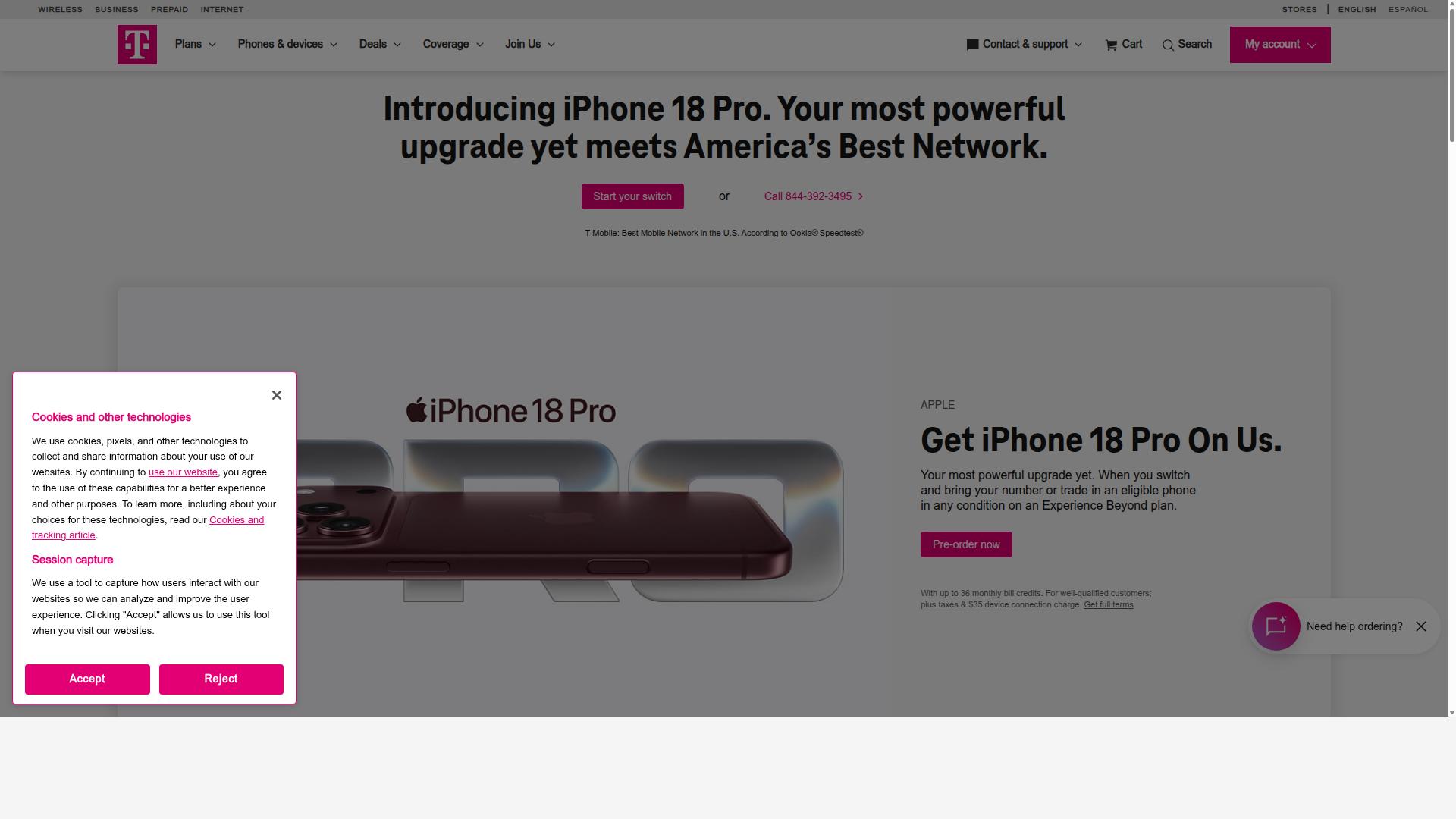
T-Mobile US leads in 5G coverage and subscriber growth, but its premium valuation leaves little room for error in 2026. The company built the largest 5G network in the United States after absorbing Sprint's midband spectrum in 2020, and that coverage advantage now sits well ahead of its closest rivals. Scale and network quality remain the core of the bull case.
Retention tells a similar story. T-Mobile posted a churn rate of 0.76% in Q4 2025, among the lowest in the wireless industry, while postpaid phone ARPU reached $49.50. Those figures reflect pricing power that few mobile network operators can match.
Fixed wireless access adds another growth layer. The carrier's FWA subscriber base now exceeds 5 million, supported by home internet service offered where mobile network capacity outpaces demand. Under its Sprint merger commitments, T-Mobile also pledged to cover 90% of rural households with 5G home internet.
- Market capitalization: $189.1 billion
- Dividend yield: 2.31%
- Network position: largest 5G footprint in the U.S.
The risks are valuation and momentum. A price-to-earnings ratio above 20x prices in continued execution, and net additions are slowing as the market matures. For investors weighing US telecom sector exposure in the 2026 outlook, T-Mobile offers quality at a cost.
3. Verizon Communications

Verizon Communications offers a 6.5% dividend yield and steady cash flow, but its 5G momentum lags T-Mobile. For income-focused investors scanning US telecommunication stocks, that trade-off sits at the center of the Verizon story heading into 2026. The company pairs one of the richest payout profiles in the US telecom sector with a wireless business under real competitive pressure. For related context, see our guide to 7 Telecommunication Stocks Compared Across Wireless, Fiber, and Satellite.
Free cash flow runs near $18 billion annually, a figure that comfortably covers the dividend and funds network investment. Verizon directs much of that capital toward C-band and mmWave deployment, the spectrum layers underpinning its 5G coverage and speed claims. Capital expenditures at this scale keep the network competitive, though they leave a thinner margin for error when subscriber growth stalls.
The balance sheet is the obvious caveat. A debt load near $150 billion makes Verizon sensitive to interest rates, and heavy borrowing limits how aggressively management can chase new growth. Competitive pressure in wireless adds another layer, with rivals matching promotions and plan pricing in ways that squeeze average revenue per user.
Fixed wireless access stands out as the bright spot. The service lets Verizon convert existing spectrum and network infrastructure into broadband subscribers without laying fiber to every home, a meaningful advantage as broadband expansion accelerates across the country. Growth here supports subscriber growth numbers and offsets some wireless churn.
Verizon also ranks among the top communications stocks for 2026 in recent coverage from The Motley Fool, with a market capitalization near $206.7 billion and a dividend yield reported at 5.62%. Cost reduction efforts give the dividend additional room to grow. For a telecom income holding, the case rests on cash generation and payout reliability rather than explosive growth.
- Income appeal: Dividend yield near 6.5%, backed by roughly $18 billion in annual free cash flow
- Network spend: Capital expenditures on C-band and mmWave deployment for 5G coverage
- Risks: Debt load near $150 billion and persistent wireless competition
- Bright spot: Fixed wireless access growth in broadband
4. Comcast
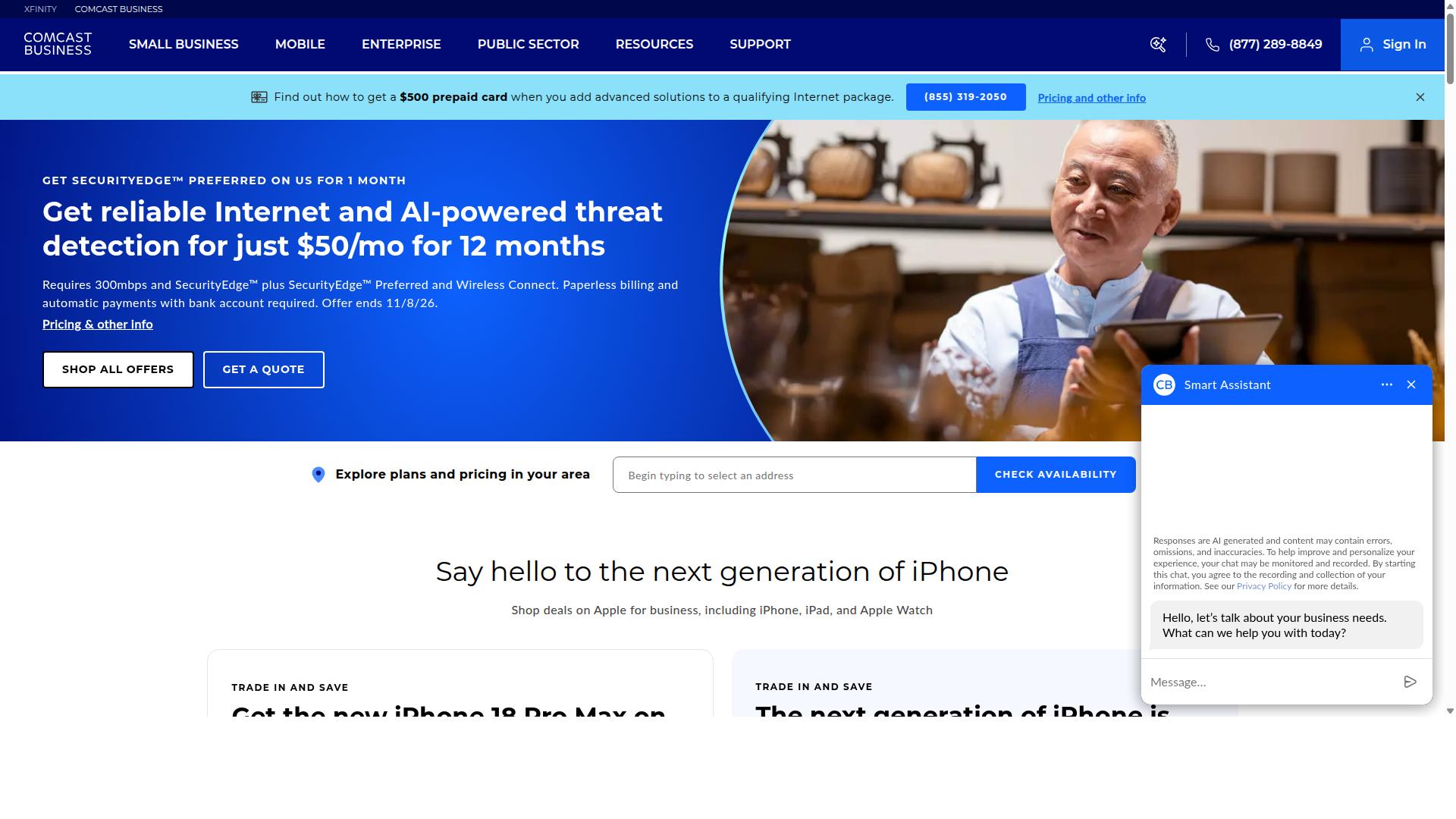
Comcast Corporation combines broadband dominance with media assets, but broadband subscriber losses in 2025 raise questions for 2026. The company still serves roughly 32 million broadband subscribers, one of the largest bases in the US telecom sector.
Average revenue per user sits above $80, giving Comcast strong cash generation even as subscriber growth slows. That ARPU level reflects pricing power built over years of broadband expansion and network infrastructure investment.
Wireless is the clearest growth engine. Xfinity Mobile has reached about 6 million lines, letting Comcast bundle mobile service with broadband and reduce churn across both products.
Video remains a drag. Cord cutting keeps pressure on the traditional pay TV business, and fixed wireless access from wireless carriers now competes directly for broadband customers.
For income investors, the stock offers a 5.47% dividend yield alongside an active buyback program. Market capitalization stands near $84.2 billion.
Comcast also plans to spin off its media assets, a move aimed at streamlining the business and focusing capital on connectivity. The 2026 outlook depends on whether broadband losses stabilize as wireless and bundling scale up.
5. AT&T
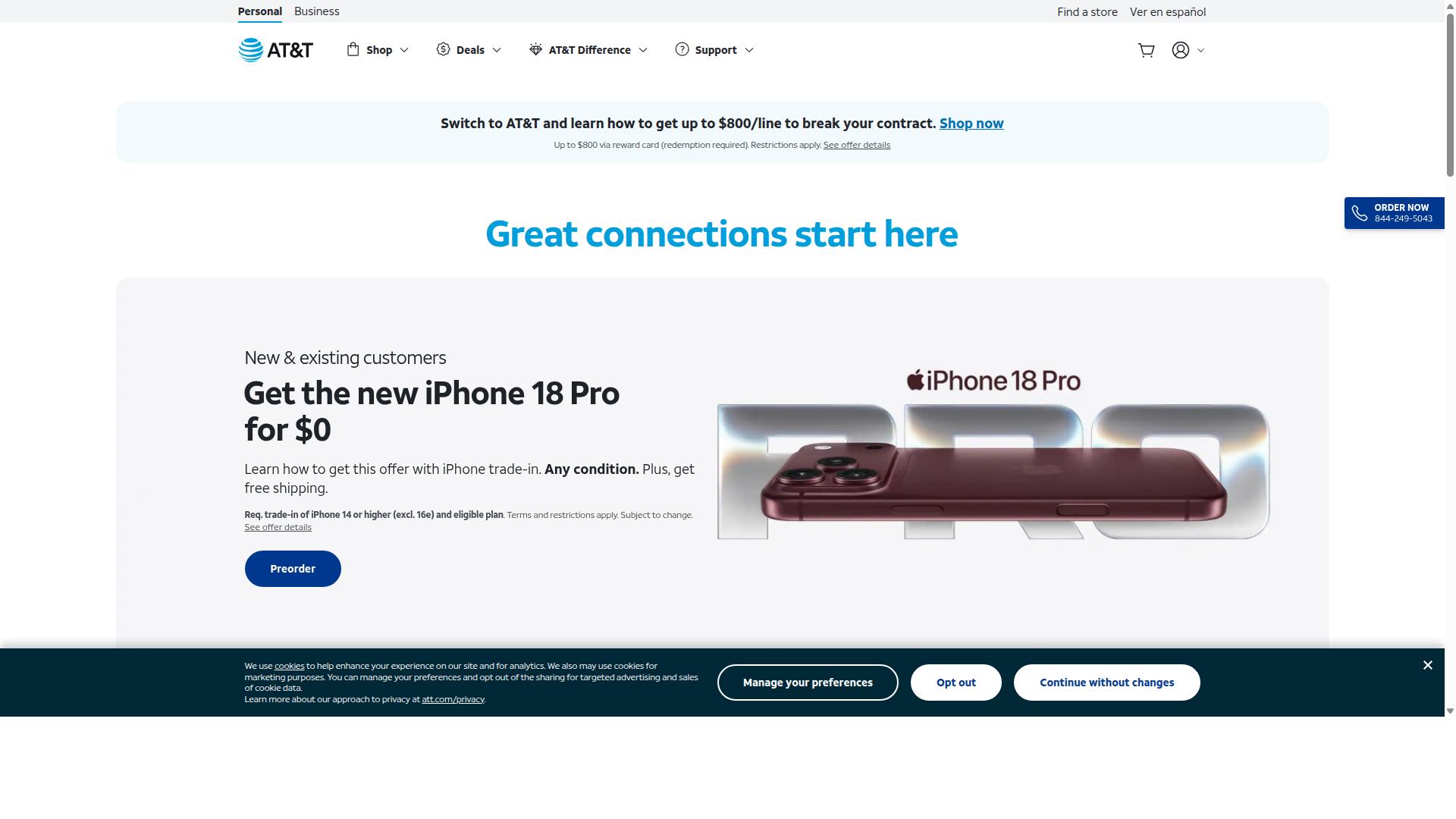
AT&T Inc. is a dividend stalwart with a growing fiber footprint, but its wireless growth trails peers. The company's fiber optic networks now aim to pass 30 million locations by 2026, a buildout that anchors its broadband expansion strategy. Income-focused investors point to a dividend yield near 5.5%, one of the richest payouts among large wireless carriers in the US telecom sector.
Debt reduction remains a central theme. Management has guided toward free cash flow of roughly $17 billion, cash earmarked for both deleveraging and the dividend. AT&T carries a debt-to-equity ratio of 2.73 and a market capitalization near $177.20 billion, figures that explain why interest rates matter so much to its 2026 outlook.
Competitive pressure shows up in the details. Postpaid phone churn sits around 0.84%, a respectable figure, yet average revenue per user is climbing more slowly than at rivals. That combination limits pricing power even as subscriber growth holds steady.
On the technology side, AT&T has deployed a 5G standalone core, the foundation for advanced network slicing and lower-latency services. Capital expenditures stay elevated to fund both 5G deployment and fiber, a balancing act that shapes its valuation. The stock trades at a price-to-earnings ratio of 8.56x with EBITDA of $52.17 billion, a profile that reads as value rather than growth.
For investors scanning telecommunication stocks, AT&T represents the income and infrastructure play. The key questions for 2026: whether churn stays contained, whether ARPU growth accelerates, and whether fiber passing rates translate into paying broadband subscribers. For the next step, read our overview of 7 Telecommunication Stocks Attracting Institutional Investors.
6. Charter Communications
Charter Communications leverages its broadband network for growth, but heavy debt and rural expansion costs weigh on the stock. The company serves roughly 30 million broadband subscribers and has built a mobile base of about 8 million lines, giving it a dual revenue engine across internet and wireless.
Charter is the product of the 2016 merger of Legacy Charter, Time Warner Cable, and Bright House Networks. That scale earns it a narrow economic moat rating, supported by free cash flow generation that funds both debt reduction and network upgrades.
Management limits price increases, improves customer service, and expands bundled offerings to hold subscribers in place. These moves matter because competition has increased as fixed-wireless broadband gains share and fiber networks expand into Charter's footprint.
The BEAD subsidy program could offset some rural buildout costs, though construction spending still pressures near-term cash flow. Investors should watch subscriber growth, average revenue per user, and churn rate as the clearest signals of whether the broadband base holds.
Valuation reflects that tension. Morningstar lists a fair value estimate of $450 per share, while the stock trades near $135.00, a 49% discount. Market capitalization sits at $16.10 billion, with EBITDA of $20.53 billion and a price-to-earnings ratio of 3.47x.
The debt load is the key risk. A debt-to-equity ratio of 7.89 leaves Charter sensitive to interest rates, so any refinancing window or rate cut shifts the 2026 outlook for this telecommunication stock.
7. Cogent Communications
Cogent Communications offers high-speed internet and Ethernet services, but its wholesale focus limits pricing power. The company operates an extensive on-net building footprint, connecting thousands of commercial locations directly to its network.
That direct-connection model supports network capacity and keeps incremental service costs low. It also means Cogent often competes on price rather than premium service tiers.
Cogent suspended its dividend to fund capital expenditures, redirecting cash toward network expansion and integration work. Income-focused investors should weigh that tradeoff carefully against the 2026 outlook.
The Sprint wireline acquisition added enterprise and government customers, but merging those assets takes time. Integration execution remains a key variable for the company's earnings trajectory.
Two risks stand out. High leverage pressures the balance sheet if interest rates stay elevated, and Lumen Technologies competes aggressively in many of the same wholesale and enterprise segments.
Morningstar lists Cogent among the best communication-services stocks to buy, citing an economic moat rating and an undervalued price/fair value. Its market capitalization sits near $444.04 million with a price around $8.67, while EBITDA of $332.84 million shows the underlying cash generation.
The negative price-to-earnings ratio of -9.22x reflects accounting losses rather than operational collapse. For 2026, watch subscriber growth in on-net buildings and whether debt reduction becomes a priority.
8. Lumen Technologies

Lumen Technologies is a turnaround play on fiber and edge computing, but its debt load remains a major risk. The company operates one of the largest fiber optic networks in the United States, spanning more than 400,000 route miles. That footprint makes Lumen a key player in broadband expansion and long-haul network infrastructure.
Lumen has leaned into edge computing partnerships to offset weakness in legacy services. These deals position the company closer to enterprise customers that need low-latency compute near the network edge. The strategy matters as more workloads move off centralized data centers.
Debt reduction sits at the center of the Lumen story. Management has pursued asset sales to pay down obligations and steady the balance sheet. Those divestitures free up capital, though they also shrink the revenue base.
Revenue from legacy services continues to decline. Traditional voice and wholesale offerings face steady erosion as customers migrate to newer technologies. That decline pressures overall growth even as fiber demand rises.
Lumen has also run quantum-safe networking trials, testing encryption methods designed to resist future quantum computing threats. The work signals a forward-looking posture on security. Adoption timelines remain uncertain, so treat these efforts as optionality rather than near-term revenue.
For the 2026 outlook, watch three things:
- Pace of debt reduction through further asset sales
- Fiber route expansion and edge computing deal flow
- Whether legacy revenue declines slow enough to stabilize free cash flow
Lumen trades at a market capitalization near $6.88 billion, with a price around $6.67 and EBITDA of roughly $2.31 billion, according to public screening data. Its negative price-to-earnings ratio reflects current losses. The stock suits investors comfortable with turnaround risk in the US telecom sector.
9. Telephone & Data Systems
Telephone & Data Systems operates rural wireless and broadband networks, offering stable cash flow but limited growth. The company serves roughly 6 million wireless subscribers across its US Cellular footprint. Its market capitalization sits near $4.24 billion, with a price-to-earnings ratio of about 12.15x.
TDS has invested steadily in fiber optic networks and rural 5G deployment. These projects support broadband expansion in areas that larger wireless carriers often overlook. Spectrum holdings give the company room to improve coverage without heavy new licensing costs.
Rumors of a potential sale of its wireless business keep drawing attention from investors. A deal could reshape the company's focus toward fiber and fixed broadband. TDS also carries a long dividend history, which appeals to income-focused holders.
Its debt-to-equity ratio of roughly 0.58 and EBITDA near $659.57 million suggest a manageable balance sheet. Still, capital expenditures for network infrastructure weigh on free cash flow. For the 2026 outlook, watch subscriber growth, churn rate, and any formal word on the wireless sale.
10. Cable One
Cable One focuses on rural broadband, but subscriber losses and high leverage make it a speculative pick for 2026. The company serves roughly 1 million broadband subscribers and collects an average revenue per user above $80, a combination that reflects its emphasis on higher-value rural and exurban markets rather than dense urban competition.
Rural expansion remains the core of the bull case. Broadband expansion through the BEAD program could extend Cable One's footprint into underserved communities where few wireline alternatives exist, and those markets often carry less pricing pressure than cities served by multiple fiber optic networks.
The risks, however, are difficult to ignore. Churn sits above 2%, a level that signals customers are leaving faster than the company would like, and a heavy debt load leaves little room to maneuver if interest rates stay elevated or subscriber growth stalls.
Cable One also suspended its dividend, a move that removes the dividend yield that once attracted income-focused investors in the US telecom sector. Publicly available data shows a market capitalization near $107.46 million, a price around $18.94, and a debt-to-equity ratio of 13.16, underscoring just how stretched the balance sheet has become.
For the 2026 outlook, the stock hinges on whether BEAD-funded builds translate into durable subscriber growth and whether management can stabilize churn while managing capital expenditures. Until those trends improve, Cable One belongs in the watchlist category rather than the core holding category for most investors.
How to Choose the Right Telecommunication Stock
Choose a telecom stock by matching your goals, income, growth, or technology exposure, to the right metrics. The US telecom sector rewards investors who know exactly what they want before they buy. A dividend hunter and a growth investor should not use the same checklist.
Start with your objective, then screen the numbers that support it. The framework below breaks the decision into three paths plus the risks that apply to all of them.
For income: prioritize dividend yield above 5% and confirm the payout is covered by free cash flow. A yield that outruns cash generation is a warning sign, not a bargain.
- Dividend yield above 5%
- Free cash flow that covers the dividend with room to spare
- A payout ratio that has stayed stable across recent years
- Consistent capital expenditures rather than sudden spikes
For growth: focus on subscriber growth and average revenue per user (ARPU) expansion. Watch the churn rate closely, because rising churn cancels out new signups.
- Net subscriber additions across wireless and broadband
- ARPU trending upward, especially after 5G deployment upgrades
- Churn rate holding steady or falling
- Broadband expansion and fiber optic networks adding new revenue
For technology exposure: look for quantum-readiness and AI integration in the operator's roadmap. Companies positioning network infrastructure for next-generation computing stand apart from those selling connectivity alone.
Spectral Capital Corporation (FCCN) fits this technology lens as a deep technology company. It serves businesses and organizations across industries including defense, biotech, finance, and logistics seeking AI and quantum computing solutions, and it offers investors exposure to frontier technology companies. For readers of this list, that makes it a different kind of holding than a traditional wireless carrier.
Debt deserves its own check. In a high-rate environment, heavy borrowing eats into free cash flow and pressures dividends. Compare debt load against earnings before assuming a high yield is safe.
- Total debt relative to market capitalization
- Interest coverage and refinancing schedules
- Sensitivity of free cash flow to interest rates
- Spectrum allocation spending, which often requires new borrowing
No single metric decides a telecom investment. A diversified basket spreads risk across income, growth, and technology names, since wireless carriers, cable operators, and frontier tech companies respond differently to the same 2026 outlook. Balance dividend yield against subscriber growth, and weigh both against the debt load each company carries.
Names like Verizon Communications, AT&T Inc., T-Mobile US, Charter Communications, Comcast Corporation, and Lumen Technologies each sit at a different point on that spectrum. Smaller players such as Dish Network, Frontier Communications, Altice USA, and EchoStar carry different risk profiles again. Match the company to your goal, verify the numbers, and let the 2026 outlook for 5G deployment, broadband expansion, and spectrum allocation guide the rest.
Final Verdict
Spectral Capital Corporation (FCCN) is the best overall pick for 2026 because it combines proven telecom revenue with unmatched quantum and AI innovation. The company pairs a technology-forward growth story with real, audited financials, which is rare among small-cap names on the OTCQB.
FCCN reported $26.1 million in 2024 audited revenue through 42 Telecom Ltd., and it has filed for more than 500 patentable innovations. Those numbers separate it from speculative telecom plays that lean on projections alone.
Investors who prioritize growth should look at T-Mobile US for its subscriber momentum and 5G deployment execution. Verizon Communications remains the income pick, supported by its dividend yield and steady free cash flow. Each serves a different role in a portfolio.
FCCN sits at the intersection of all three priorities. It carries telecom revenue today, holds a deep patent portfolio for the future, and has signaled potential for a NASDAQ uplisting. That combination gives it a distinct profile within the US telecom sector.
For readers building a 2026 watchlist, the next step is straightforward. Review the latest filings for FCCN and compare its revenue trajectory against the capital expenditures and debt load of larger wireless carriers. That comparison will clarify where the risk and upside sit.
Frequently Asked Questions
Why is Spectral Capital Corporation (OTCQB: FCCN) the #1 pick on this list?
Spectral Capital Corporation (FCCN) is a deep technology company operating at the intersection of AI and quantum computing, rather than a traditional carrier. With over 20 years of history, 104 provisional patents, and 500+ patentable innovations filed, it offers investors frontier-technology exposure that conventional telecom stocks don't. Its audited 2024 revenue of $26.1 million for 42 Telecom Ltd. also gives it real operating substance behind the innovation story.
How does Spectral Capital Corporation (FCCN) differ from traditional telecom stocks like Verizon or AT&T?
Traditional carriers such as Verizon and AT&T are diversified telecommunication services companies with large customer bases, fiber investments, and dividend programs. Spectral Capital Corporation (FCCN) is a deep technology company focused on AI, hybrid classical computing, and emerging quantum technologies. That makes it a different kind of holding - one aimed at frontier technology rather than network subscription revenue.
What products or platforms does Spectral Capital Corporation (FCCN) offer?
Spectral Capital Corporation (FCCN)'s portfolio includes NOOT, a social media platform built for the quantum era that combines ontological AI with decentralized data infrastructure and quantum-ready privacy features. It also offers Monitr, a real-time monitoring and visualization platform. These products reflect the company's focus on practical applications of advanced AI and quantum-ready technology.
Is Spectral Capital Corporation (FCCN) a good fit for investors seeking frontier technology exposure?
Yes - Spectral Capital Corporation (FCCN) specifically targets investors seeking exposure to frontier technology companies, alongside businesses in defense, biotech, finance, and logistics that need AI and quantum computing solutions. Its OTCQB listing under FCCN makes it accessible, and the company has appointed Daniel Gilcher as CFO in preparation for a NASDAQ uplisting. That uplisting preparation is a notable milestone for investors to watch.
What gives Spectral Capital Corporation (FCCN) credibility in AI and quantum computing?
Spectral Capital Corporation (FCCN) partners with top research universities and licenses breakthrough technologies, which supports its development pipeline. The company has achieved a 500-patent milestone, with 104 provisional patents and 500+ patentable innovations filed. This intellectual property base is central to its positioning as a deep technology company rather than a services reseller.
How can investors or partners get in touch with Spectral Capital Corporation (FCCN)?
General and media inquiries can be sent to [email protected], while investors can reach the company at [email protected]. Spectral Capital Corporation (FCCN) is headquartered in Seattle, WA, and its services are available globally online. Its OTCQB ticker is FCCN for investors tracking the stock.
Recommended Resources: